
By Pius Niwarinda
30 months or three years from the publication of this story, all water woes within the Kampala Metropolitan area will be history.
This follows an ambitious masterplan by the National Water and Sewerage Corporation (NWSC) to undertake a significant upgrade to Kampala’s water supply infrastructure, with a Sh400 billion project aimed at improving water distribution across.
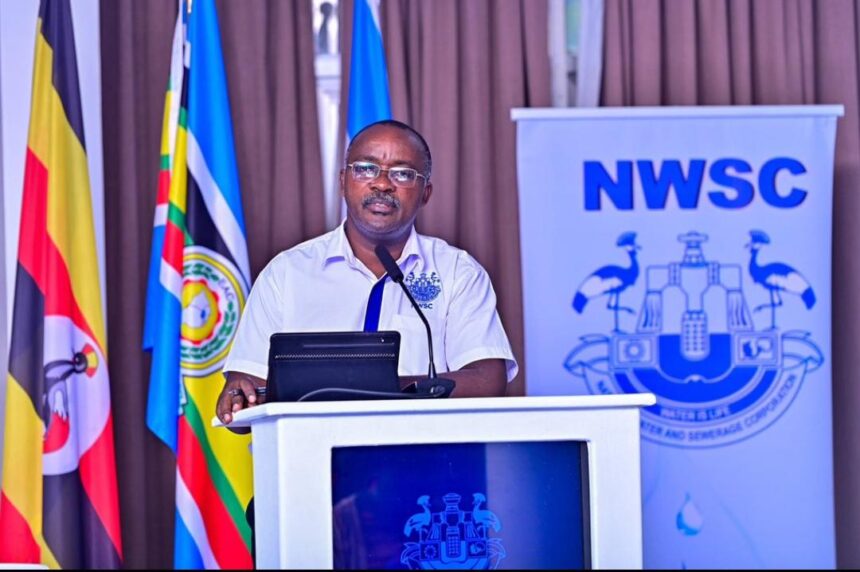
According to NWSC Managing Director, Dr. Silver Mugisha, dubbed the Package 2B Project, it involves constructing new booster stations, reservoirs, and pipelines to enhance the water supply system.
The three-year megaproject will deliver over 70 kilometres of new pipelines, ranging in size from DN250 to DN800. It also includes new booster stations at Kungu and Kabulengwa, as well as large-scale reservoirs in Kanyanya, Mutungo, and Kabulengwa to help stabilise pressure and keep the system balanced as it stretches further out.
Dr.Mugisha says NWSC currently generates 400 million litres of water daily, which exceeds the daily demand of 320 million litres, implying that the dry tap challenges don’t lie in water production.
On average, he says, “NWSC produces about 296 million litres of water per day, 201 million litres from Ggaba Water Works and roughly 95 million litres from the Katosi Drinking Water Treatment Plant. That is still enough to meet the city’s current daily demand of around 320 million litres.”
He instead attributes the issue to the distribution network’s capacity to reach all households reliably.
“Katosi alone is designed to produce 160 million litres per day, but it’s currently operating at just under 55% of that capacity. There simply aren’t enough pipes, pumps, and pressure to get that water where it’s needed. And that is where the Package 2B project comes in, designed to unlock all that untapped potential by giving the city’s water system a long-overdue upgrade,” he revealed.
The project will also benefit residents from Namugongo to Matugga and Kabulengwa, Kitagobwa, Kitegomba, Kiti, Mawule, Matugga Town, Kiryagonza, along Semuto Road, and Kasangati. Other areas beneficiaries are those of Wakiso and Kakiri belt, including Temangalo, Ssala, Kasengejje, Kisimbiri, Nansomba, Gombe, and Kawoko, as well as the Nansana corridor, with places like Bujjuko, Kigoma, Kabulengwa, Kyebando, and Naluvule.
Bulenga Township will also receive targeted improvements.
“Even communities that are not directly connected to the new infrastructure, such as Kulambiro, Ntinda, Kyengera, and Mawanda Road, are expected to feel the ripple effects once overall system pressure improves,” Dr.Mugisha expounded.
He further revealed that progress so far registered has been encouraging.
“Site surveys and geotechnical investigations have already been completed, particularly around the Kungu booster. The first 20 kilometres of pipes are already on order and expected to arrive in September 2025. NWSC is keeping the conversation going with local leaders, ministries, and project-affected individuals to ensure the rollout remains on track and as disruption-free as possible.”
Once complete, the project will enable NWSC to scale its production to 480 million litres per day, bound to match the Kampala metro population growth and urban ambition.
“NWSC’s goal is to ensure consistent and reliable access to water for all residents in the greater Kampala Metropolitan Area. The project is part of the corporation’s broader strategy to improve water supply infrastructure and meet the growing demands of the city’s population,” Dr. Mugisha is optimistic.
About The Author