By Dr. Arinaitwe Rugyendo
ResearchFinds News | Kampala, Uganda
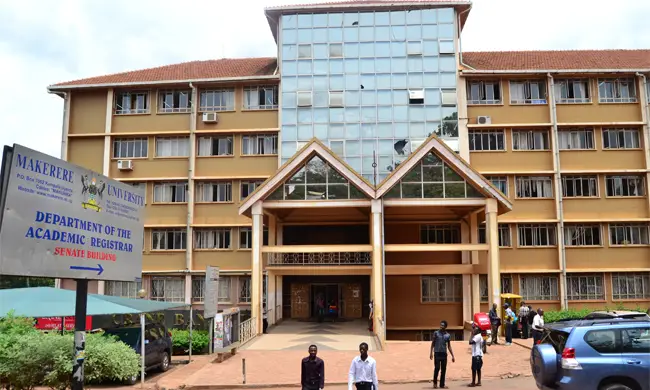
Researchers at Makerere University have concluded its Senate Building exhibits brittle structural characteristics that may limit its performance under significant ground shaking from an earthquake.
The investigation, titled “Seismic Vulnerability Assessment of Existing Buildings at Makerere University,” was conducted by Charles Gavamukulya, Moses Matovu, and Allan Ray Okodi from the Department of Civil and Environmental Engineering in 2025.
During the study that re-examined assumptions about seismic risk in Uganda’s capital, the engineers found that the mid-rise reinforced concrete structure of the building exhibits limited ductility—a key property that allows buildings to absorb seismic energy through controlled deformation rather than sudden failure.
The findings indicate that the building reaches critical damage thresholds at relatively low lateral drift values, a characteristic associated with brittle rather than ductile structural response.
“Results indicate that Senate building has a total base shear of 4800 kN thereby resisting more lateral force before failure than high rise buildings,” the researchers note in their journal article published in the ASRIC Journal on Engineering Sciences, Vol.6(1)(2025) 10-36; available online at https://asric.africa/engineering-sciences
The researchers also note that the Senate building might reach the Significant Damage limit state at lower drift values when compared to high rise buildings thereby suggesting brittle behavior.
In the context of structural engineering and materials science, brittle behavior refers to a material’s tendency to fail or break suddenly with little to no prior deformation (stretching or bending).
While a ductile material (like mild steel) will stretch and give you a visual warning before it snaps, a brittle material (like glass, cast iron, or unreinforced concrete) reaches its limit and shatters instantly.
“Results also indicate that Senate Building showed moderate resilience reaching the Near Collapse limit state at 0.56g. These findings highlight the urgent need for retrofitting existing buildings in Makerere University particularly for mid-rise buildings and advocate for updating the current seismic code to address seismic vulnerability assessment of existing buildings,” the researchers warn.
The research team was motivated by an identified gap in national disaster preparedness. While Uganda sits within the seismically active East African Rift System (EARS), the country’s building codes—specifically the aging US 319:2003—offer limited guidance on assessing and protecting existing structures against seismic loading.
Structural Assessment: Strength and Ductility Characteristics
To characterize the building’s structural behaviour, the researchers developed a detailed computational model of the Senate Building and subjected it to Nonlinear Static Pushover Analysis. This method applies incrementally increasing lateral loads to evaluate how the structural frame responds and at what point damage thresholds are reached.
The results reveal an important distinction between lateral strength and deformation capacity. The Senate Building demonstrates considerable lateral resistance, capable of withstanding a total base shear of 4,800 kN—greater than many of the university’s taller structures. However, this high stiffness is accompanied by limited ductility.
“The Senate Building reaches the Significant Damage (SD) limit state at much lower drift values than high-rise buildings,” the researchers found. In practical terms, while a taller building may dissipate seismic energy through gradual deformation, the Senate Building’s stiffer frame concentrates stress and reaches its damage threshold more abruptly, consistent with brittle structural behaviour.
Fragility Analysis and Seismic Damage Probability
Using the Capacity Spectrum Method, the team developed “fragility curves”—probabilistic charts that predict the likelihood of damage at different levels of shaking. The data shows the building reaches a “Near Collapse” (NC) state at 0.56g of spectral acceleration.
While 0.56g may appear to be a technical abstraction, it represents a credible scenario for Kampala. The city’s proximity to the Western Rift Valley makes it susceptible to shallow crustal earthquakes. The researchers reference the 1966 Tooro earthquake, which caused 160 fatalities, as evidence of the region’s documented seismic history.
If a similar event were centred closer to the capital, the Senate Building’s distributed mass response and higher-mode vibrations could produce a significant torsional (twisting) effect that the existing reinforced concrete frame was not designed to accommodate.
Risk Context: Occupancy, Records, and Monitoring Gaps
The study’s findings carry important implications for the large number of students and staff who occupy the Senate Building daily. The researchers highlight a compounding set of risk factors: a high-occupancy building housing critical academic records, constructed under outdated design standards, in a region with limited seismic monitoring infrastructure.
“The concentration of vulnerable buildings in a densely populated educational environment creates a critical gap in disaster preparedness,” the paper concludes.
The study notes that the Senate Building’s reliance on stiffness rather than deformation-based energy dissipation increases the likelihood of a brittle failure mode, which may provide limited warning time for occupants.
Recommendations: Structural Retrofitting and Policy Reform
The researchers go beyond identifying vulnerabilities, offering concrete recommendations for risk mitigation. The paper calls for a targeted programme of seismic upgrades across the university’s building stock.
For the Senate Building, the engineers propose targeted retrofitting—selectively strengthening the structure without demolition.
Key recommendations include: Column Jacketing – which is the use of Fiber-Reinforced Polymer (FRP) wrapping to confine the concrete columns, giving them the ductility to bend without shattering.
Secondly, adding concrete Shear Walls to distribute and absorb lateral seismic loads more effectively.
Thirdly, a policy reform that would lend the Uganda National Bureau of Standards (UNBS) impetus to revise the current code and adopt a modern framework that specifically addresses vulnerability assessments for existing building stocks in the country.
About the Senate Building
Inaugurated in 2001 and officially opened by President Yoweri Museveni, the Senate Building stands as the administrative heart of Makerere University, serving as the primary hub for the institution’s central governance and academic management.
Architecturally prominent with its multi-level, reinforced concrete design, the building houses the Office of the Academic Registrar, the Directorate of Research and Graduate Training, and the Senate Room, where the university’s supreme academic organ meets to formulate policies.
It is the nerve center for critical student services, including admissions, examinations, transcripts, and records, while also providing office space for various administrative directorates and the Council Room, making it the most significant site for both high-level decision-making and day-to-day academic processing within the university.
The 2020 Main Building Fire
The September 2020 fire that severely damaged Makerere’s Main Building provides a relevant point of comparison for the seismic concerns raised in this study. While the fire demonstrated the vulnerability of historic timber and masonry to thermal events, the current engineering findings point to a different category of structural risk within the modern concrete of the Senate Building that warrants similar attention.
For university administrators, the 2020 fire underscored the importance of protecting irreplaceable records and institutional heritage; this study reinforces that disaster preparedness must extend beyond fire safety to include the structural assessment and retrofitting of key administrative facilities.
The 2020 fire demonstrated that even prominent campus landmarks are susceptible to major damage. The brittle behaviour identified in the Senate Building represents a structural risk of a different nature—one in which the onset of failure may be less gradual and the window for response more limited.
Verdict
As Makerere University celebrates over a century of academic leadership, this research serves as a stark reminder that physical infrastructure must evolve as fast as the minds within it.
The work of Gavamukulya, Matovu, and Okodi has shifted the conversation from if a building is strong enough to how it will fail.
In the case of the Senate Building, the identified failure mode is brittle, with meaningful implications for life safety. The findings present the university with a clear basis for prioritising investment in seismic retrofitting as part of a broader commitment to infrastructure resilience.
Technical Note: For engineers and policymakers seeking the full data sets, the original paper, including the eigenvalue results and demand spectra generated from the PEER NGA database, is available for academic review.
Full Research Access: The full paper can be obtained from
Available online at https://asric.africa/engineering-sciences
For more deep dives into the research shaping Uganda’s future, stay tuned to ResearchFinds News on X handle and our Portal to share your research findings.
About The Author