ResearchFindsNews.com Science Desk
Kampala – Uganda: A deep-data investigation into National Water and Sewerage Corporation (NWSC)’s half-century expansion, its weekly water quality surveillance system, its UGX 104 billion tax contribution, has revealed the water body could close the remaining 15% coverage gap by 2030 to honour Uganda’s universal water access pledge.
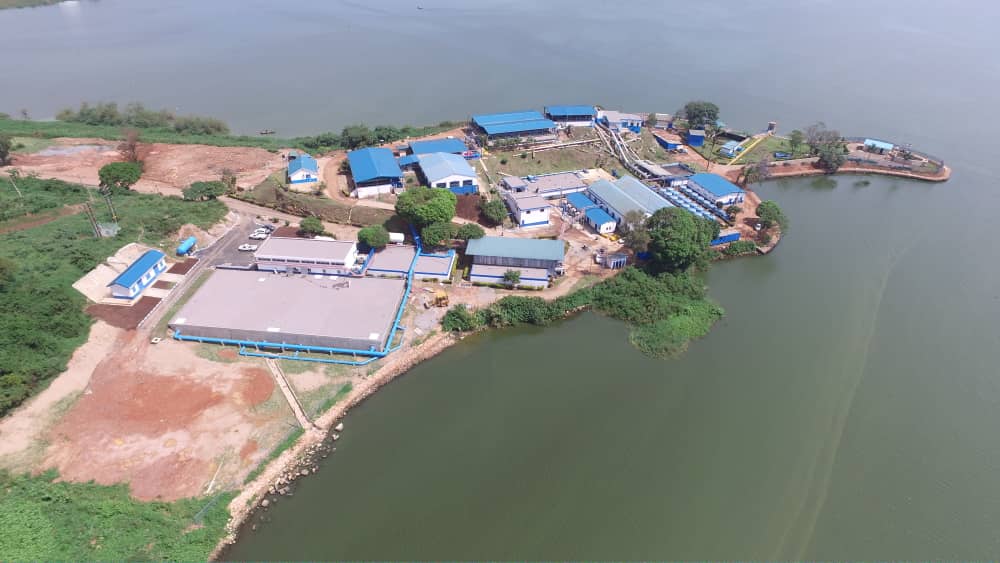
Every week, without announcement, NWSC publishes a document that most Ugandans have never read. It contains the pH of the water that flows from taps in Kampala. It records the turbidity of the water treated at the Ggaba and Katosi plants on Lake Victoria’s shores.
It logs the residual chlorine levels left in the supply network to kill any bacteria that survive the treatment process. It tracks E. coli counts. It measures electrical conductivity.
This document the NWSC Weekly Water Quality Report has been published consistently since at least 2025, issued every Monday covering the preceding seven days. It is one of the most underreported transparency tools of any public utility in East Africa.

And what it reveals, when read carefully, is a corporation quietly executing one of the continent’s most ambitious water infrastructure programmes with a technical rigour that its own communications rarely celebrate.
The true story of Uganda’s water transformation lies in a series of staggering, often overlooked milestones that trace a journey from a modest utility to a continental empire.
Since 1972, the National Water and Sewerage Corporation has expanded from just 26,000 connections to nearly one million in 2024, now serving 21 million citizens across 282 towns and 96 districts.
This massive scale is anchored by a sprawling network of 22,721 kilometers of pipes a distance exceeding half the Earth’s circumference and supported by 71 treatment plants operating nationwide.
Beyond infrastructure, the corporation has emerged as a financial powerhouse; its annual revenue has surged 34% over the last five years to reach UGX 622 billion, contributing a significant UGX 104 billion in taxes to the national treasury and proving that utility expansion can be both a social lifeline and a driver of national economic growth.
The coverage revolution: from one in five to four in five
In 1972, when NWSC was established by Presidential Decree No. 34, it operated in just seven towns and served fewer than 500,000 people. Coverage stood at approximately 20% of Uganda’s urban population. The water pipe network totalled 750 kilometres. The asset base was worth USD 12.6 million.
More than five decades later, the transformation is staggering in its scale. Coverage now stands at 80% of the urban population.
The corporation operates across 282 towns, spanning all five regions Kampala, Central, Northern, Eastern, and Western/South-Western with 150 branches serving 96 of Uganda’s 136 districts.
Its asset base has grown to USD 1.015 billion. Its water pipe network, at 22,721 kilometres, could wrap halfway around the planet.
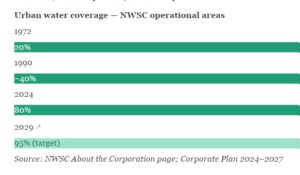
The goal, set in the Corporate Plan 2024–2027, is to reach 95% coverage by 2029 serving 25 million people through 1.2 million connections and generating revenues of USD 1.57 billion.
To close that remaining 15-percentage-point gap, the corporation must extend services to an additional 4 million people over four years, in areas that are, by definition, the hardest to reach and most expensive to connect.
What is in the water and how is it kept safe?
Water safety is not a destination. It is a process and NWSC’s process runs seven days a week, 52 weeks a year, across every water treatment plant in its network.
The Weekly Water Quality Report, published every Monday on the NWSC website, tracks eight critical parameters for Kampala Water, the largest of its operational areas.
NWSC publicly states that its water conforms to both Uganda National Bureau of Standards (UNBS) standards and WHO guidelines, and the corporation is one of very few utilities in sub-Saharan Africa to publish weekly water quality data on an open-access website.
The reports, available from August 2025 through December 2025 and beyond, provide a continuous, verifiable public record of water quality, a level of transparency that most African water utilities have not achieved.
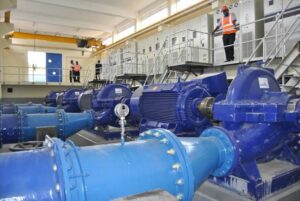
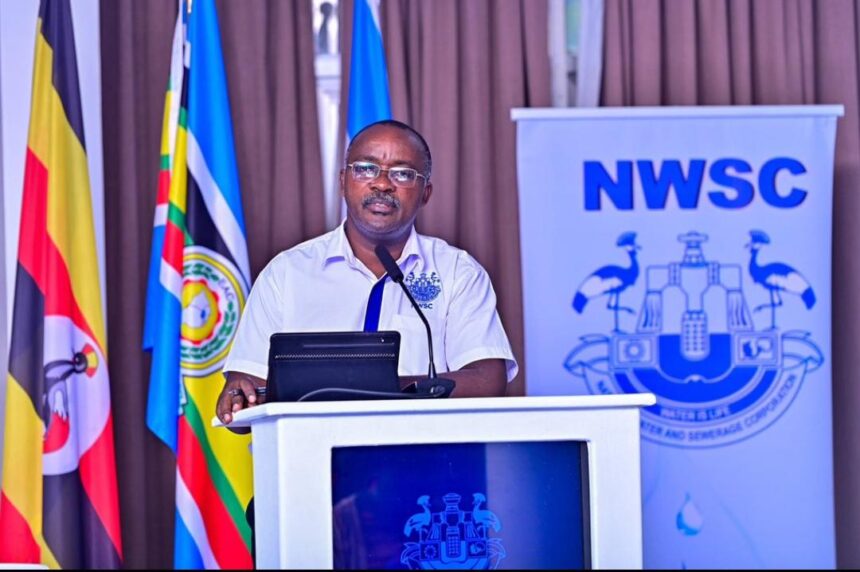
“The critical parameters, colour, turbidity, microbiology, residual chlorine and aluminium, are monitored on a daily basis before the water leaves the water treatment plant. Daily monitoring is also done in the supply network,” reveals NWSC Publicist Sam Apadel.
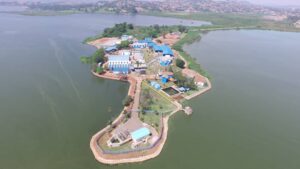
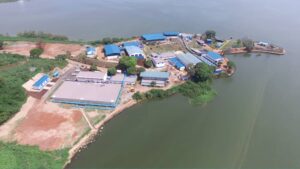
Indeed, the treatment process begins at the source. NWSC abstracts raw water from lakes (primarily Lake Victoria in Kampala), rivers, dams, swamps, and groundwater sources across its 71 Water Treatment Plants nationwide.
The water undergoes a multi-stage treatment process coagulation, flocculation, sedimentation, filtration, and chlorination, before being pumped through 22,721 kilometres of transmission and distribution mains, boosters, and reservoirs to reach homes, schools, hospitals, industries, and public standpipes.
Reservoirs are cleaned twice a year on a scheduled basis, with emergency cleaning triggered if monitoring results indicate a quality deviation. The corporation monitors its network daily, testing at both the treatment plant and within the distribution system, to detect any post-treatment contamination before it reaches the consumer’s tap.
UGX 104 billion: the invisible dividend
One of the most significant and least-reported facts about NWSC is its contribution to Uganda’s national treasury.
Over the five-year period covered by the corporation’s sustainability reporting, NWSC paid UGX 104 billion in taxes, making it one of the more substantial tax-paying public entities in Uganda’s utility sector.
This figure sits alongside equally striking financial performance indicators. Revenue grew 34% over five years, from UGX 463 billion to UGX 622 billion. Operating profits rose 32%, from UGX 103 billion to UGX 142 billion.
These profits have been reinvested into infrastructure extending water supply, upgrading treatment plants, and improving customer service delivery rather than distributed as dividends to a private shareholder.
For a corporation wholly owned by the Government of Uganda, this represents a compound return: NWSC simultaneously delivers a public service to 21 million people, operates commercially to fund its own expansion, and contributes directly to the national fiscal base.
Industries, trees, and the 46% discount nobody knows about
Two aspects of NWSC’s operations are almost completely absent from public discourse. The first is its industrial water programme.
The corporation operates dedicated water supply systems for 10 established industrial parks across Uganda, and provides a subsidised industrial tariff of UGX 2,500 per cubic metre, 46% below the standard commercial rate, to industries that use water as a major production input.
Currently, 228 industries benefit from this pricing, a direct subsidy from the utility that reduces production costs and supports Uganda’s industrialisation agenda under the National Development Plan.
The second is the “Treevolution Programme.” Over the past four years, NWSC has planted 5,863,511 trees, nearly six million, at schools, religious institutions, government offices, NWSC installations, and water source catchment areas.
This is part of a 10 million tree target implemented in partnership with the National Forestry Authority (NFA), the Uganda People’s Defence Force, school water and sanitation clubs, and the Ministry of Water and Environment.
The programme is not merely environmental window-dressing: it is a water security strategy. Trees protect catchment areas, reduce runoff, and stabilise the water sources that feed NWSC’s treatment plants.
The sewerage gap: the story inside the story
For all its water success, NWSC’s sewerage coverage remains a persistent and largely unexamined policy problem. Of 282 towns served, only 17 have centralised sewerage systems. The sewer pipe network totals just 764 kilometres — compared to 22,721 kilometres of water pipes. Sewer connections stand at only 30,301, compared to 995,071 water connections.

This disparity is not simply an engineering challenge. It is a public health one. Without adequate sewerage infrastructure, faecal waste from the 96% of connected households that lack sewer access enters the environment through pit latrines, septic tanks, and open drainage ultimately threatening the very water sources that NWSC treats.
The corporation operates faecal sludge treatment facilities at Buwama, Bukakata, Ntungamo, Mayuge, and two Kampala sites (Lubigi and Bugolobi), and is developing a Sanitation Investment Plan (SIP) to expand sewerage access. But the gap between water and sewerage coverage is the largest unresolved infrastructure deficit in Uganda’s urban water sector.
What 2030 requires
NWSC’s 2030 projections are, on their own terms, extraordinary: 350 operational towns, 25 million people served, 1.2 million connections, 95% coverage, and USD 1.57 billion in revenue.
But they depend on a set of enabling conditions that the corporation cannot control alone: continued government capital investment in infrastructure, sustained broadband and mobile money integration for customer payments, regulatory support for tariff adjustment, and critically policy action on digital literacy and connectivity that will determine whether Ugandans in underserved areas can access NWSC’s e-services and manage their water accounts digitally.
The water is clean. The coverage is growing. The finances are sound. The trees are being planted. But the 15% of urban Ugandans who remain without piped water access, the 96% who lack sewerage connections, and the 4 million people who must be connected in the next four years to meet the 2029 target are the measure by which this corporation’s transformation will ultimately be judged.
The weekly water quality reports will keep being published every Monday. The question is whether the people who need to read them and act on them are paying attention.
About The Author