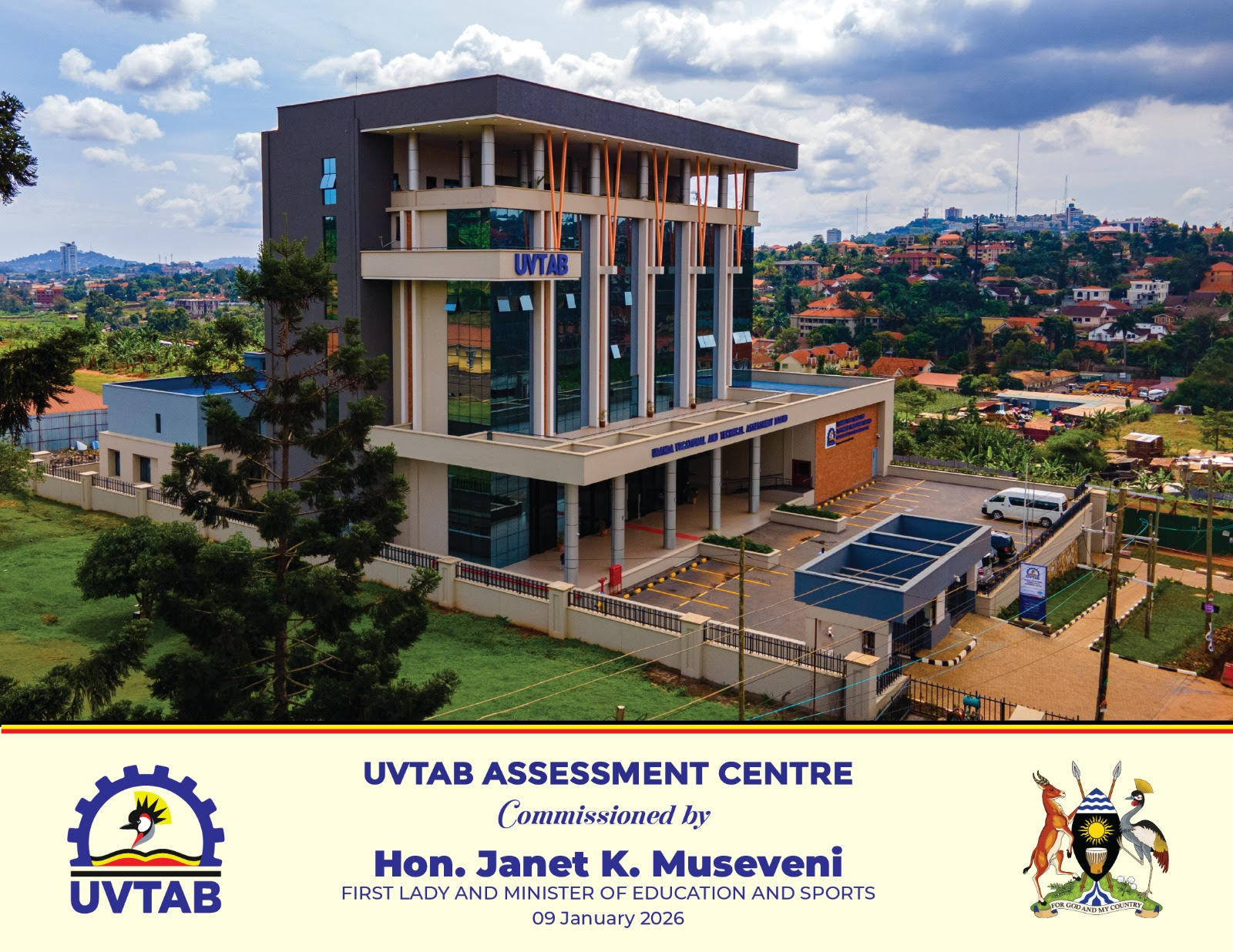
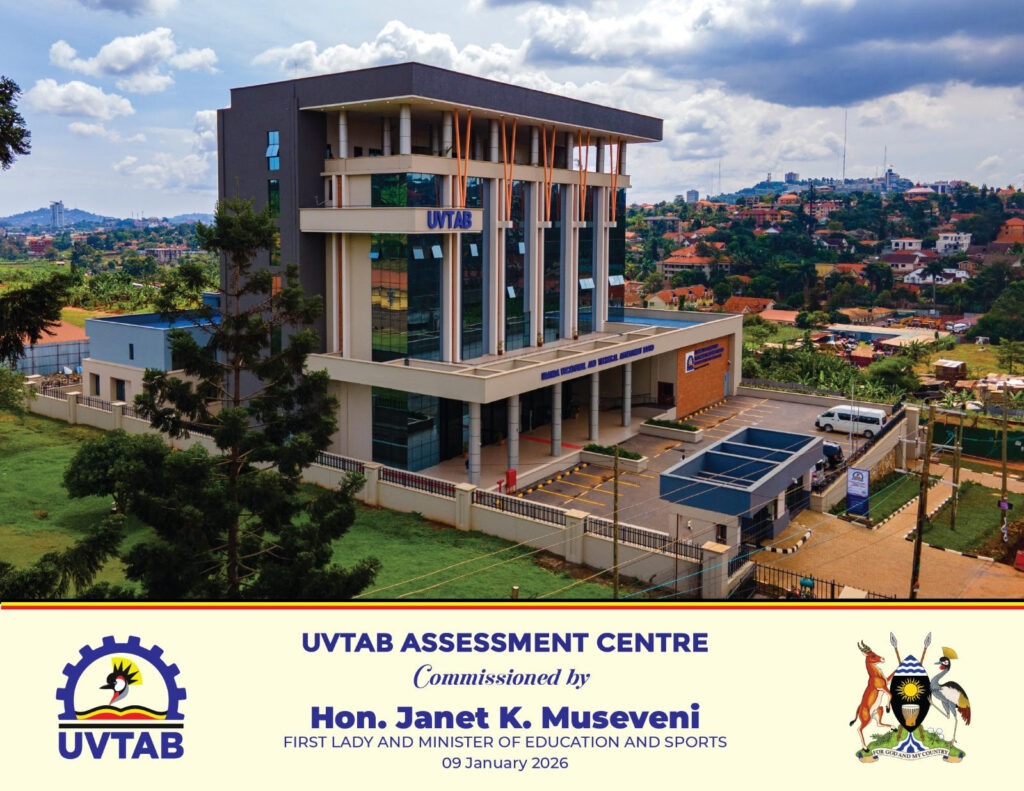
KAMPALA – Tomorrow, Friday, January 9, 2026, the skyline of Kyambogo Hill will officially welcome a new landmark of educational transformation. The First Lady and Minister of Education and Sports, Hon. Janet K. Museveni, is slated to commission the newly constructed eight-storey headquarters of the Uganda Vocational and Technical Assessment Board (UVTAB).
This is not just another government building. The state-of-the-art complex, completed in a record three years, serves as the ultimate “National Skills Assessment Centre.” It stands as a physical manifestation of a 40-year journey—moving from the fragmented, neglected vocational tracks of 1986 to a centralized, high-tech engine for national industrialization.
Ending the “Diaspora” of Assessment
For years, UVTAB’s operations were scattered across multiple rented locations, including Plot 7 Valley Drive, Plot 2 Suuna Road in Ntinda, and offices along Jinja Road. This fragmentation was more than a logistical headache; it was a symbol of the “second-class” status vocational education once held.
By consolidating all staff into this single, purpose-built facility, the Board is poised to skyrocket its operational efficiency. While the specialized UVTAB Printery will be established separately at the Namanve Industrial Park for security and industrial reasons, the Kyambogo headquarters will now serve as the “brain” of the BTVET (Business, Technical, Vocational Education and Training) revolution.
The 1986 “Fallback” vs. The 2026 “First Choice”
To appreciate the milestone of this building, one must look at the data from 1986. At the start of the current administration, vocational education was a “colonial relic” designed to produce clerks. In 1986, there were fewer than 50 technical institutes, and their assessment was largely an afterthought.
Today, as Uganda nears the 40th Anniversary of the NRM administration on January 26, the numbers tell a different story. Vocational education is no longer a “fallback” for those who failed the academic ladder; it is a statistically verifiable first choice for thousands.
Key Data Highlights of the Transformation:
In terms of growth and impact, the data reveals a transformative shift in Uganda’s vocational landscape. Enrollment has reached unprecedented levels, with over 30,619 candidates sitting for assessments in the May–June 2025 cycle alone. This surge is accompanied by a landmark shift in gender parity; 17,423 of these candidates were female, a statistic that signals a profound departure from the long-held gendered perceptions of technical and “blue-collar” work.
This massive participation is supported by an expansive institutional network that now oversees more than 500 accredited assessment centers across the country—a staggering leap from the handful of centers that existed in the late 1980s. Most importantly, the quality of this education is being validated by performance, with the most recent results posting a 91% overall success rate. This high achievement level serves as a clear indicator that the Competence-Based Education and Training (CBET) model is not only being adopted but is effectively equipping the Ugandan workforce with the practical skills required for the 2026 economy and beyond.
The Symbolism of Kyambogo Hill
“The commissioning of this headquarters is a signal to the youth of Uganda that their skills are worth the best facilities we can offer,” notes a senior researcher at ResearchFinds. “By placing this Assessment Centre on Kyambogo Hill, the government is physically elevating the status of the technician to match that of the traditional academic.”
The new facility will streamline the Board’s “modularization” strategy. This allows the population—which has grown from 15 million in 1986 to over 48 million today—to access quick, certified skills training that leads directly to the job market.
Looking Ahead
The Eight-Storey Assessment Centre is equipped to handle the digitization of vocational exams, a move that will cut down the turnaround time for results and certification. As Hon. Janet Museveni cuts the ribbon tomorrow, the message is clear: The “job seeker” era of 1986 is being buried under the weight of concrete, data, and skilled hands.
With the UVTAB Printery soon to follow at Namanve, Uganda’s capacity to assess and certify its own workforce is now a sovereign reality. As the nation looks toward the 2026 milestone, the technical class finally has a home that matches its contribution to the economy.
FACTSHEET OF THE FACILITY
- Location: Kyambogo Hill, Kampala (The traditional heart of Uganda’s technical education).
- Cost of Construction: Shs 25.6 Billion.
- Structure: Eight-storey Main Block + Three-storey “Short Tower” (6,400+ Sq. Metres of floor space).
- Operational Efficiency: Consolidates staff from four separate rented locations in Ntinda and Lugogo Bypass.
- Key Features: National Skills Assessment Centre, Innovation & Incubation Hubs, Industrial Printery (at Namanve), and staff wellness facilities including a crèche for breastfeeding mothers.
RECENT PERFORMANCE HIGHLIGHTS (MAY–JUNE 2025 SERIES)
- Total Registered Candidates: 30,619 [00:23].
- Gender Dynamics: 17,423 (57%) Female vs. 13,196 (43%) Male [01:15].
- Institution Type: 61% from formal training institutions; 39% from informal/private providers [01:00].
- Competence Rate: 91% of candidates successfully attained full competence in their respective modules.
- New Assessment Cycles: To accommodate the high demand for skilling, UVTAB is shifting to four assessment cycles per year (March, June, September, December) [03:52].
STRATEGIC IMPACT OF THE NEW HQ
- Cost Saving: Eliminates an annual rent expenditure of Shs 189.8 Million, redirecting funds toward modular curriculum development.
- Modularization Hub: The facility is designed to manage the “Modular Assessment” system, allowing youth to be certified for specific skills in as little as 3–6 months to combat unemployment [02:54].
- Unified System: Since the merger of UBTEB and DIT (Directorate of Industrial Training), this HQ serves as the single point of truth for all technical, business, and home science certifications in Uganda [02:07].
- Security of Exams: With the establishment of the dedicated UVTAB Printery at Namanve, the integrity and turnaround time for vocational certificates are now fully localized and secured [03:14].
“The commissioning of this headquarters is a signal to the youth of Uganda that their skills are worth the best facilities we can offer. We have moved from a nomadic existence to a permanent home of excellence.” — Onesmus Oyesigye, UVTAB Executive Secretary.
About The Author