By Liz Ingabire
KAMPALA – A ground breaking PhD study at Makerere University has unveiled a model for managing Uganda’s refugee settlements. If this model by the Office of the Prime Minister (OPM), the government agency handling refugee issues, it will help a great deal in managing tensions between host communities and refugees over land tenure.
While the global refugee crisis intensifies, with Uganda as the world’s gold standard for its radical hospitality, this study has identified a critical vulnerability in this generosity: the handshake deals that govern refugee land use. The study titled: A Tenure Arrangement for Refugees on Custom Land, was conducted by Ms. Sophie Nagujja at the College of Engineering, Design Art and Technology, Makerere University.
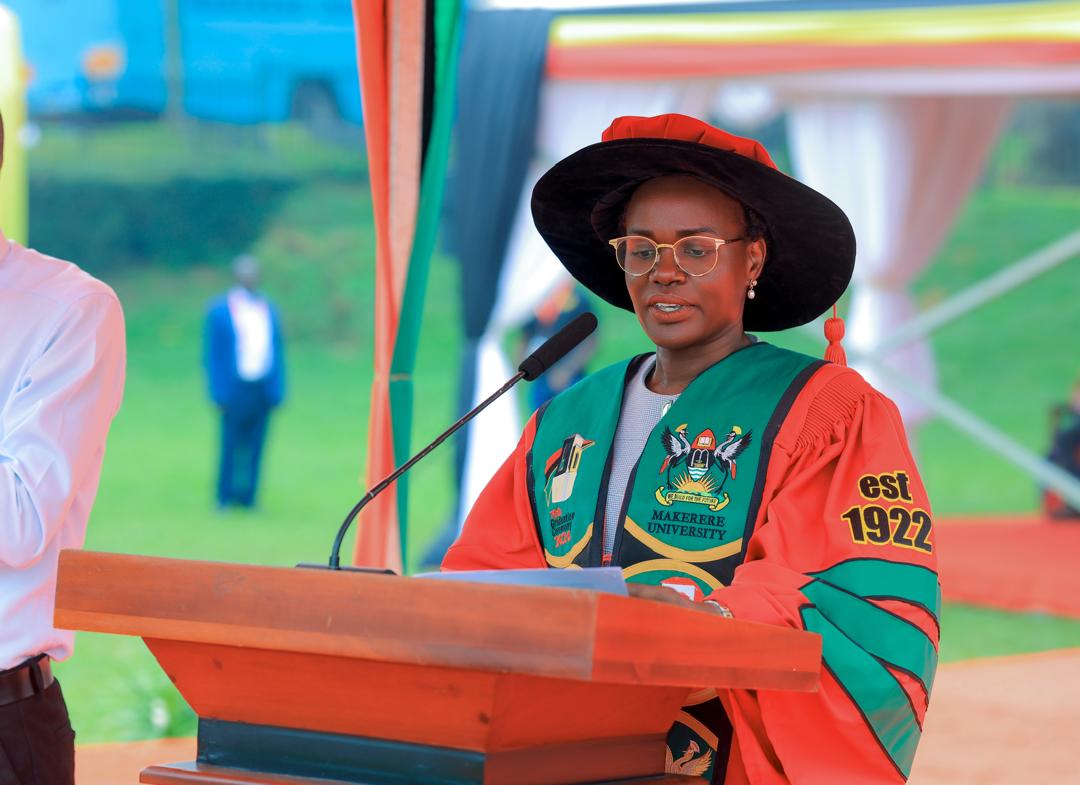
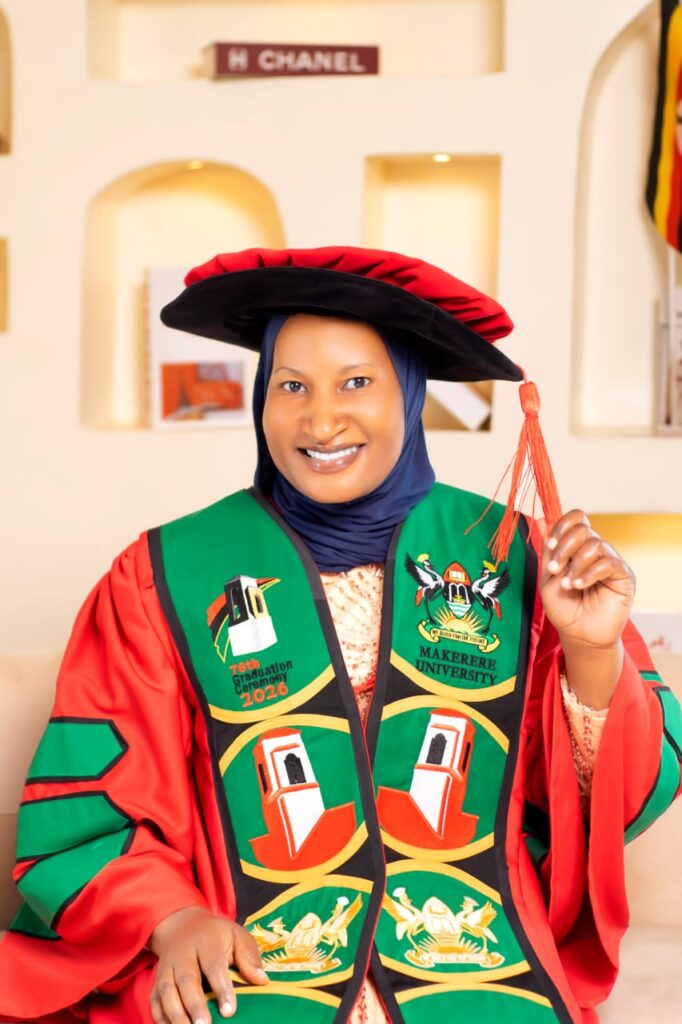
The study has led to Ms. Nagujja being awarded the degree of Doctor of Philosophy at this year’s graduation ceremony at Makerere. The study introduces a land management model whose utility is to protect the OPM and the local citizens who host millions of refugees in various settlements across the country.
The study observes that the for years, the OPM has engaged in a delicate balancing act to avoid conflicts in host communities. The OPM, according to the study, has often engaged in negotiations with customary landowners to voluntarily offer land for refugee settlements.
But while this act is meant to be formalized through Memoranda of Understanding (MoUs), the study reveals that the implementation often falls short. According to the study, this situation has left gaps which leave rights, restrictions and responsibilities of both the refugees and landowners in a legal grey zone, occasioning a critical tenure security risk.
The study, which privileged a mix of design thinking and interviews with experts, found out that the obtaining land acquisition practices continuously violate international standards of voluntary land donation. The process currently in Uganda lacks transparency which has left host communities feeling insecure about their ancestral holdings, while refugees remain uncertain about their long-term access to the soil, they till to feed their families.
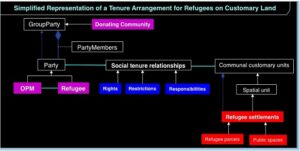
As a solution, the study has proposed a high-tech, legally tight remedy embedded in a tenure arrangement compliant with the Land Administration Domain Model (LADM). This model acts as a digital and legal bridge, recognizing all social tenure rights for both parties simultaneously.
“It moves away from vague promises toward a framework that is transparent, locally contextualized, and internationally recognized,” Ms. Nagujja tells this website.
A key pillar of the proposed model is the introduction of new local institutions mandated by Ugandan law which would work hand-in-hand with the OPM to manage land conflict between refugees and host communities, ensuring that tenure security remains the central focus of every settlement expansion.
“By decentralizing the oversight, the OPM can maintain its strategic coordination role while ensuring that local grievances are handled with legal precision,” suggests Ms. Nagujja. The study concludes that continuing with the status quo compromises the very stability Uganda has worked so hard to build. It calls on the OPM and relevant Ministries to prioritize the formalization of land agreements and the operationalization of this new tenure arrangement.
By adopting this PhD-vetted model, the Office of the Prime Minister can transform its refugee policy from a humanitarian gesture into a legally fortified national asset ensuring that Uganda remains a global leader not just in heart, but in the sophisticated governance of its most precious resource: land. Ms. Nagujja has also translated this study into two peer reviewed journal articles that have been published by the African Journal of Land Policy and Geospatial Sciences (AJLP&GS)
The first article is titled: “A need for a tenure arrangement for refugees on customary land” which can be accessed at https://doi.org/10.48346/IMIST.PRSM/ajlp-gs.v6i5.43167
The second article is titled “Customary Land Acquisition and Tenure Security in Refugee-Host Communities: An Impact Assessment in Northern Uganda. It can be accessed at https://doi.org/10.48346/IMIST.PRSM/ajlp-gs.v8i9.60598 and was co-authored with Moses Musinguzi, Lilian Oryema and Ismail Wadembere.
As of the final quarter of 2025, Uganda has solidified its position as Africa’s leading refugee-hosting nation, providing sanctuary to an immense population of over 1.96 million refugees and asylum seekers. This humanitarian commitment places the country among the largest hosts globally, with the Office of the Prime Minister (OPM) managing a demographic that is overwhelmingly vulnerable; approximately 78% of the total population consists of women and children, while 55% of all displaced persons are under the age of 18.
The geographical distribution of this population is heavily concentrated in rural areas, with 91% of refugees residing across 13 designated settlements. While urban centers like Kampala and Wakiso host about 9% of the total, the vast majority of displaced persons are integrated into the countryside.
The Bidibidi settlement in Yumbe District remains the largest in the country, housing over 236,700 individuals, followed closely by Adjumani with approximately 219,600 and the expansive Rhino Camp. Together with Pagirinya, these three hubs alone account for more than half of the country’s total refugee presence.
The crisis remains dynamic, driven by ongoing regional instability. Since early 2022, over 443,000 new arrivals have crossed into Uganda, including more than 69,000 people fleeing the conflict in Sudan since 2023. Currently, the refugee population is dominated by those fleeing the South Sudan conflict (55.1%) and the Democratic Republic of Congo (30.9%).
These populations are supported across a network of key settlements, including Nakivale, Kyaka II, Palabek, and Rwamwanja, which continue to serve as critical pillars of Uganda’s integration-based humanitarian strategy.
About The Author