By Ivan Tibenkana
Entebbe- Uganda: As Ugandans head to the polls in a few months’ time, the manifesto of the ruling National Resistance Movement (NRM) party is leveraging aviation data, achievements, or projections to bolster claims about infrastructure, economic growth, or regional connectivity.
In the attempt to tackle both local and international mobility tasks ahead, Uganda Civil Aviation Authority (UCAA), is immersed in a growth strategy aimed at registering a 10-fold economic transformation.
Being the entity that oversees Entebbe International Airport and other aviation facilities across the country, UCAA has committed itself to maximum support towards Uganda’s push for the 10-fold economic growth strategy as the country seeks a $500bn economy by 2040, as envisaged in candidate Yoweri Museveni’s manifesto of the ruling NRM party.
The commitment, according to UCAA Spokesperson Vianney Luggya, is currently overseeing progressive investment in aviation infrastructure and the Uganda Airlines for efficient and affordable air transport.
“This will ultimately harness tourism, affordable passenger flights, agricultural and other exports,” he told us in a casual chat recently.
In 1962, Uganda’s Gross Domestic Product (GDP) was $449m (Sh1.5tn), currently at $63bn, the country anticipates much more by 2040 and efficient transport will be critical in facilitating trade and travel.
With its five-year rolling business plans, UCAA has plugged into Uganda’s Vision 2040 which among others demands for an integrated transport infrastructure network that bridges air, road, rail and water.
“All these plans are aligned with the respective national development plans and the National Resistance Movement’s (NRM) manifestos that seek major socio-economic improvements.” Says Mr. Luggya.
Unfolding
In 2021, UCAA marked 30 years of streamlining the air transport industry and the broader contributions to economic growth since inception in 1991. This was achieved through implementation of the respective development plans.
The National Development Plan (NDP) II (2015/16-2019/20), and NDP III (2020/21-2024/25). The current NDPIV (2025/26-2029/30) and the National Transport Masterplan, will equally be influential towards charting the aviation industry’s future.
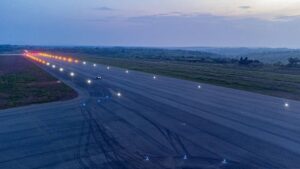
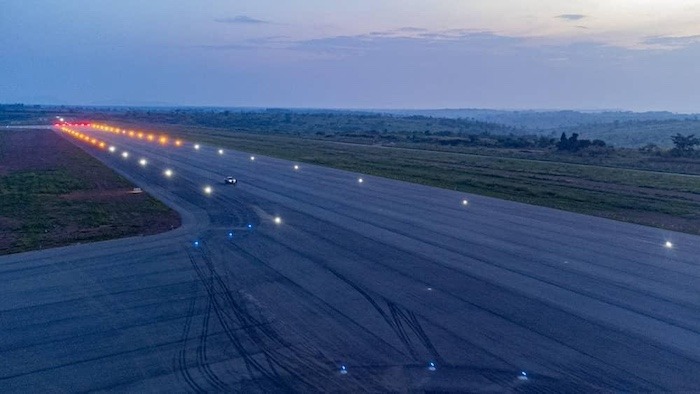
Several deliverables from NDPII and other targets in subsequent NDPs have been well-tracked. The current NRM manifesto anticipates major upgrades including rehabilitation of existing airports and aerodromes, capitalizing Uganda Airlines to acquire more aircrafts and open up extra routes, operationalizing Kabalega International Airport and completing the expansion and modernization of Entebbe International Airport.
More Passengers, Affordable Flights
Entebbe International Airport has recorded gradual progress in commercial aviation traffic, from 5,615 flights in 1991 to over 2.3m flights last year. Currently, Uganda Airlines is the largest operator at Entebbe International Airport, with a 24% market share for outbound flights, up from 4% in 2019, its year of resumption.
Additionally, there has been an impactful drop in travel costs with a return air ticket for instance to Nairobi having stabilised at about $400 compared to $800 in 2019.
Overtime, several improvements have been recorded. The upgrade and expansion of Entebbe International Airport, revival of the national airline in 2019 and development of Entebbe International Airport into a hub were achieved in NDPII.
In the same space, a new baggage handling system was installed at the airport. To climax this, there are currently 17 destinations including extra routes across Africa such as to Lagos, and Europe, including London.
The airport recorded the highest passenger traffic in history in July this year with more arrivals than departures, all influenced by the 2024 Championship of African Nations (CHAN24) tournament, a highlight of the lucrative sports industry and tourism. 119,127 arrivals were recorded and 111,450 departures, averaging 7,437 passengers per day.
The airlines’ revenue has increased to Sh411bn in FY 2023/24 from Shs28 bn in FY 2019/20. With increased capitalisation and acquisition of additional aircrafts, there is certainty about improvements in efficiency and available direct and cheaper flights to more destinations.
Cargo Handling
From the bales of cotton lint that made their way by rail to the Lancashire mills in the 1900s, to a now competitive logistics market powered in part by the revamped aviation industry, commercial cargo has easily found its way to international export markets.
At Entebbe, there is more flow of exports from horticulture, floriculture and fish. On the other hand, there is anticipation for the looming oil and gas from the Albertine graben, courtesy of the upcoming Kabalega International Airport.

Through the Civil Aviation Authority’s 2017/18-2021/22 business plan, the much-needed systems certification, a crucial factor in the competitive export market was attained following the ISO 9001:2008 for quality management systems at Entebbe, Moroto, Mbarara, Tororo, Soroti, Kisoro, Masindi, Kasese, Jinja, Kidepo, Gulu, and Arua airports.
Except for the downturn during the COVID-19 Pandemic, Entebbe International Airport’s cargo portfolio has been on a spiral. From 15,222 tonnes in 1991 to 18,161 tonnes of imports in 2023. As for exports, the volume has appreciated from 1,367 tonnes in 1991 to 40,911 tonnes in 2023 with fresh produce still leading. Upon completion, Kabalega International Airport is set to be a crucial trade point for the oil and gas sector as it’s poised to handle the majority of the industrial cargo.
“Collectively, International and local travel will further be reinforced upon completion of aerodromes in Arua, Gulu, Pakuba, Jinja, Kisoro and Kasese, crucial towards trade and tourism, major sources for the much-needed domestic revenue,” Reveals Luggya.
In October this year, Uganda was elected as a member of the International Civil Aviation Organization Council for the 2025-2028 term. The Council is responsible for setting standards and recommended practices for the global aviation industry. With such milestones and commitment to transformation, the authority emphasizes its role in the country’s quest for socio-economic growth.
About The Author