By Pius Niwarinda
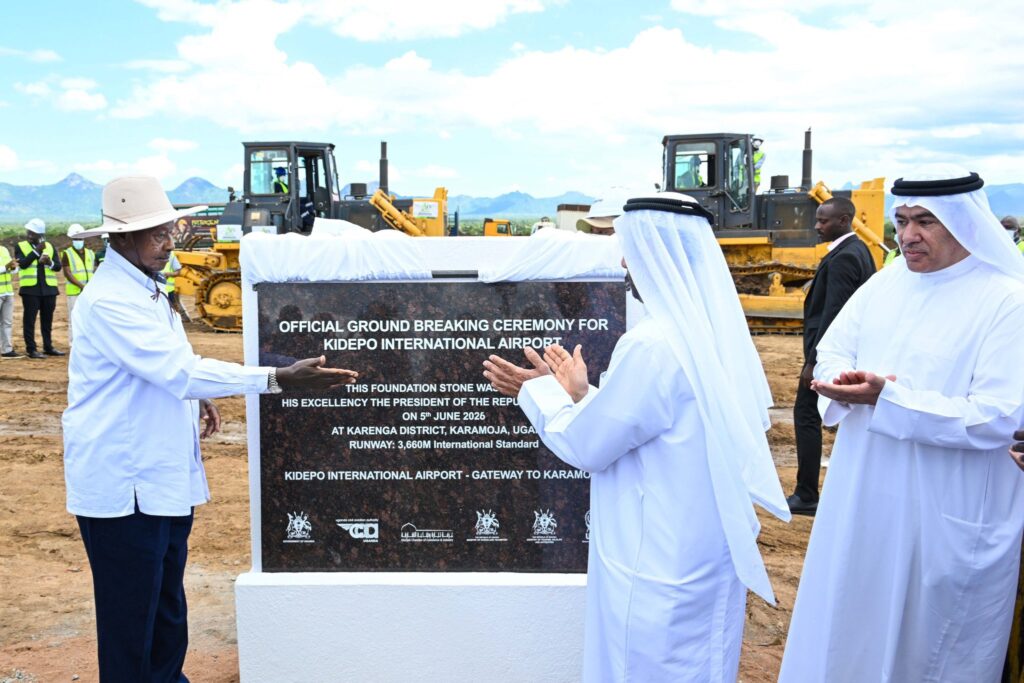
KARENGA — President Yoweri Kaguta Museveni travelled to Karenga District on Friday this week to personally break ground for the construction of Kidepo International Airport, one of Uganda’s most consequential infrastructure projects in recent memory.
In launching the construction, he set in motion a real-world test of one of development economics’ most consistent findings: that aviation infrastructure in previously isolated regions correlates with measurable growth in tourism receipts, foreign direct investment, and local employment.
The ceremony, held in the remote north-eastern district that borders South Sudan, marked the physical beginning of a project that has moved from bold presidential declaration to shovel-in-ground reality.
The Kidepo Airport Project
The planned airport, to be built at Lomej, approximately three kilometres south of Kidepo Valley National Park headquarters and 456 kilometres northeast of Entebbe, will feature a main runway measuring 3,600 metres — long enough to receive a Boeing 777 and similar wide-body aircraft.
When fully operational, it is expected to handle up to two million passengers annually, serving not only Uganda’s northeastern region but also providing a connectivity gateway to South Sudan and Turkana County in Kenya.
Karimojong-dancers
The project is anchored by a Memorandum of Understanding signed between the Government of Uganda and the Sharjah Chamber of Commerce and Industry of the United Arab Emirates, under which the Sharjah Chamber agreed to construct the airport and to develop tourist hotels within Kidepo Valley National Park.
The arrangement makes Kidepo International Airport — which will become Uganda’s third international airport which is a product of Gulf investment in one of Africa’s most storied but least accessible safari destinations.
The symbolism of the ground-breaking was deliberate, and its development significance difficult to overstate. Karamoja — Uganda’s north-eastern frontier — was for decades defined by cattle raiding, food insecurity, and armed conflict, and ranked consistently among the country’s lowest-scoring regions on human development indices. It was among the last parts of Uganda to be fully integrated into the post-independence development story.
What the Research Says
Research on infrastructure-led regional transformation in comparable African contexts — from Ethiopia’s Hawassa Industrial Park to Rwanda’s Eastern Province — suggests that flagship public investment of this kind can catalyse measurable shifts in private investment and household income within five to ten years, provided the enabling conditions of security, governance, and market connectivity are in place.
For instance, a 2019 World Bank impact evaluation of Ethiopia’s Hawassa Industrial Park, described as the Ethiopian government’s flagship industrialisation project, found that large-scale, location-specific public investment of this kind has measurable implications for workers and the rural communities from which they originate, with the park employing up to 24,000 people at its peak and attracting 19 international firms.
In 2025, a University of Cape Town study on air connectivity in Africa found that aviation infrastructure plays a critical role in addressing distance barriers to trade and that air connectivity acts as an enabler for tourism, FDI, and economic growth more generally, with the African Union itself identifying aviation infrastructure as critical to regional integration and intra-African trade.
A panel study of Africa’s ten most visited tourist destinations, covering the period 1995 to 2019, found that FDI has a positive and significant impact on tourism arrivals, and that governance quality strengthens that relationship, a finding with direct relevance to Karamoja, where improved security and governance are the preconditions on which Kidepo’s economic case rests.
More interesting is that a 2009 World Bank study on Africa’s infrastructure deficit found that inadequate infrastructure decreases annual economic growth by two percentage points and reduces business productivity by up to 40 percent, making the inverse case equally clear: well-placed infrastructure investment, in regions where the deficit is most acute, carries the highest potential return.
Kidepo Airport: The Economics Case
The economic case for the airport rests on a well-documented gap between natural asset quality and visitor access.Kidepo Valley National Park is home to lions, giraffes, elephants, and buffalo, and is widely regarded among safari researchers and travel writers as one of Africa’s most pristine and least spoiled wilderness destinations.
Its wildlife density and ecological diversity rival those of Uganda’s more accessible parks, yet its visitor numbers have historically been constrained by the access problem: reaching Kidepo from Kampala requires either a ten-hour overland journey or a light aircraft connection that most international tourists do not use.Studies of tourism economics in sub-Saharan Africa consistently find that access infrastructure, roads, airstrips, and airports — is among the most significant determinants of visitor volumes and per-visitor spending.

A runway capable of receiving charter flights from Europe and direct connections from the Gulf does not merely improve convenience; it restructures the market entirely, opening Kidepo to the high-yield safari segment that has proved transformative for Kenya’s Maasai Mara and Tanzania’s Serengeti.
Kidepo and the UCAA Agenda
The Kidepo ground-breaking does not stand alone. It is the latest chapter in a comprehensive national aviation transformation that the Uganda Civil Aviation Authority has been executing across the country simultaneously.
A newly completed 20,000-square-metre passenger terminal at Entebbe International Airport, commissioned in phases from January 2026, is set to boost Entebbe’s annual handling capacity from two million to at least 3.5 million passengers, with a longer-term target of five million by 2029.
The data from 2025 suggests that target is realistic: by November of that year, Entebbe’s international passenger traffic had already reached 2,247,145 — surpassing the entire 2024 annual figure before December had even begun.
Kabalega International Airport in Hoima, designed to serve Uganda’s emerging oil and gas sector, is nearing completion and is scheduled for operationalisation in 2026.
Gulu Airport is being fast-tracked to international status. Kasese is earmarked for upgrade to a fully equipped Code 4 international facility. Navigation aids have been upgraded at Entebbe, Soroti, Kasese, Hoima, and Gulu.
Uganda has concluded Bilateral Air Services Agreements with 64 countries. And in a marker of Uganda’s growing credibility in global aviation governance, the country has been elected to the International Civil Aviation Organization Council for the 2025-2028 term — a recognition that carries both symbolic and practical weight for a country seeking to position itself as a regional aviation hub.
From the shores of Lake Albert in Hoima to the savannah plains of Karamoja in the northeast, Uganda is simultaneously constructing, upgrading, or planning international airports at Entebbe, Hoima, Gulu, Kasese, Arua, Kisoro, and now Kidepo.
It is the most ambitious airport development programme in the country’s history. Whether it also becomes the most economically productive will depend, as the research literature on infrastructure investment consistently emphasises, not only on the quality of the runways but on the quality of the complementary investments in hospitality, in road connectivity, in skills, and in institutional capacity that determine whether the planes that land bring the growth that is promised.
KIDEPO AIRPORT: KEY FACTS
Location: Lomej, Karenga District, Karamoja
Developer: Sharjah Chamber of Commerce & Industry (UAE)
Runway Length: 3,600 metres
Aircraft Capability: Boeing 777 and wide-body equivalents
Annual Capacity: Up to 2 million passengers
Status: Runway construction groundbreaking — 5 June 2026
Distance from Entebbe: 456 kilometres northeast
Regional Reach: Uganda, South Sudan, Turkana County (Kenya)
About The Author