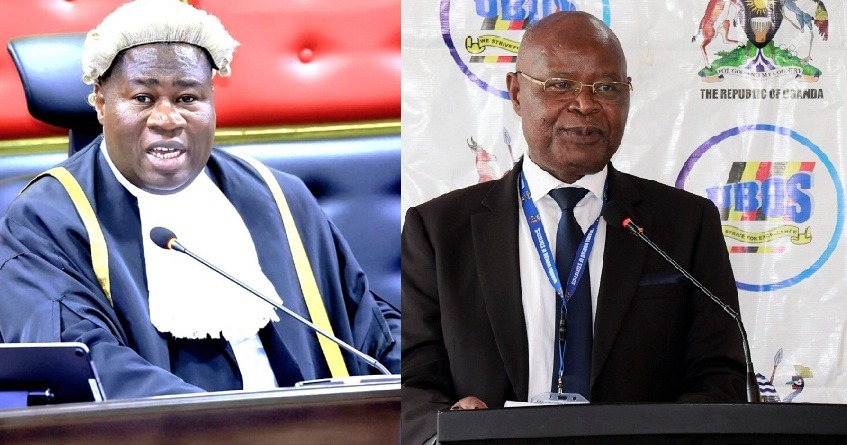
KAMPALA — The Uganda Bureau of Statistics (UBOS) has moved to strengthen the use of official statistics in parliamentary debate, budgeting and government oversight, inviting Speaker of Parliament Jacob Oboth-Oboth to officiate at a two-day workshop for Members of Parliament.
In a letter dated October 5, 2026 and received by Parliament the following day, UBOS Executive Director and Chief Statistician Dr Chris N. Mukiza invited the Speaker to serve as Chief Guest at the workshop on Monday, October 12, at 9:00am.
The Sensitisation and Engagement Workshop for Parliamentary Committees on the Production and Use of Official Statistics is scheduled for October 11–12 at Speke Resort Munyonyo in Kampala.
The engagement targets MPs serving on three committees whose work is central to national resource allocation and economic policy: the Budget Committee, National Economy Committee, and Finance, Planning and Economic Development Committee.
The invitation follows an earlier letter dated August 21, 2026, through which UBOS sought the Speaker’s approval to engage members of the committees.
A wealth of official data
The workshop comes at a time when Uganda is generating an expanding body of official statistics covering population, poverty, economic growth, inflation, health, education, governance and public finance.
Among the Bureau’s most significant datasets is the National Population and Housing Census 2024 which recorded Uganda’s population at 45,905,417 people as of May 2024.
The census final report was published in December 2024, with subsequent profiles providing more detailed information at sub-region, district, parish and ward levels.
UBOS has also made census information accessible through a public dashboard, providing data on households, population distribution and demographic trends.
The Uganda National Household Survey 2023/24, the eighth such survey since 1999/2000, put Uganda’s national poverty rate at 16.1 percent, down from 20.3 percent in 2019/20.
However, the national figure masks significant regional disparities. In Karamoja, for example, household poverty increased from 65 percent to 74.2 percent, highlighting the importance of using disaggregated evidence when designing and allocating public programmes.
In February 2026, UBOS also released the National Governance, Peace and Security Survey Report 2024/25 adding to the evidence available to policymakers on governance and public service delivery.
Economic indicators are updated more frequently.
On September 30, UBOS reported annual inflation of 4.6 percent for the month of September 2026, compared with 4.1 percent in August.
Preliminary UBOS estimates also put Uganda’s economic growth for the 2025/26 financial year at 6.4 percent, with the size of the economy estimated at Shs250.447 trillion.
Beyond individual reports, UBOS maintains a range of platforms through which researchers, policymakers and the public can access statistical information, including its data dissemination portal, microdata archive, spatial data portal, gender and Sustainable Development Goals databases, as well as the UGSTATS mobile application.
The datasets cover areas ranging from crime, education and health to energy, external trade and government finance.
Taking evidence into parliamentary debate
The UBOS initiative comes early in the life of the 12th Parliament, whose leadership has emphasised the importance of evidence in legislative and oversight processes.
After his election as Speaker on May 25, 2026, Oboth-Oboth outlined seven pillars to guide the House, including evidence-based debate, results-based budgeting and proactive oversight.
The objectives of the UBOS workshop directly align with these priorities.
According to Dr Mukiza’s invitation letter, the engagement is intended to deepen MPs’ understanding of official statistics and promote their effective use in public debate, evidence-based planning, policy formulation and monitoring of government programmes.
For Parliament, the practical value of the data lies in its ability to connect national policy decisions to conditions on the ground.
An MP debating the allocation of resources to a particular locality, for instance, can draw on census data to establish population size and household characteristics. Similarly, parliamentary committees examining economic projections can compare assumptions on growth, inflation and other indicators against independently produced official statistics.
Such evidence can also help Parliament identify disparities hidden by national averages.
The decline in national poverty, for example, does not necessarily mean that all regions have benefited equally. The deterioration in poverty levels in Karamoja demonstrates why policymakers need detailed data when determining where resources and interventions are most urgently required.
Committees at the centre of resource decisions
The three committees targeted by UBOS occupy a particularly important position in Parliament’s financial and economic oversight architecture.
The Budget Committee plays a central role in scrutinising national budget proposals and allocations, while the National Economy Committee considers matters relating to Uganda’s economic development.
The Finance, Planning and Economic Development Committee, meanwhile, handles key issues relating to taxation, public finance, planning and economic policy.
Equipping members of these committees with a deeper understanding of official statistics could therefore influence how evidence is interpreted during debates on public expenditure, borrowing, taxation, economic growth and government programmes.
The engagement also comes at an early stage of the new Parliament’s five-year term, providing an opportunity to establish data-driven approaches to legislative work from the outset.
From data production to data use
For UBOS, the workshop represents more than an exercise in disseminating reports.
The Bureau’s mandate extends from producing official statistics to ensuring that the information reaches and informs decision-makers.
With increasingly large volumes of data now available through digital platforms, the challenge is increasingly shifting from producing statistics to ensuring that they are understood, correctly interpreted and effectively used.
The October engagement is therefore intended to bridge the gap between the country’s statistical system and one of its most important users—the legislature.
The Speaker is expected to officiate at the workshop at Speke Resort Munyonyo at 9:00am on Monday, October 12.
Copies of the invitation were sent to the Clerk to Parliament and the chairpersons of the three targeted parliamentary committees.
UBOS has designated its Principal Public Relations Officer, Didacus Okoth, as the contact person for coordination.
Dr Mukiza concluded the invitation by thanking the Speaker for his continued support towards statistical production and development.
About The Author