By Pius Niwarinda
KAMPALA: The National Water and Sewerage Corporation (NWSC) has dramatically expanded its footprint over the past decade, growing from a utility serving just 23 towns to one now operating across 290 towns, with its asset base shooting from about Shs580 billion to a valuation of Shs6.2 trillion.
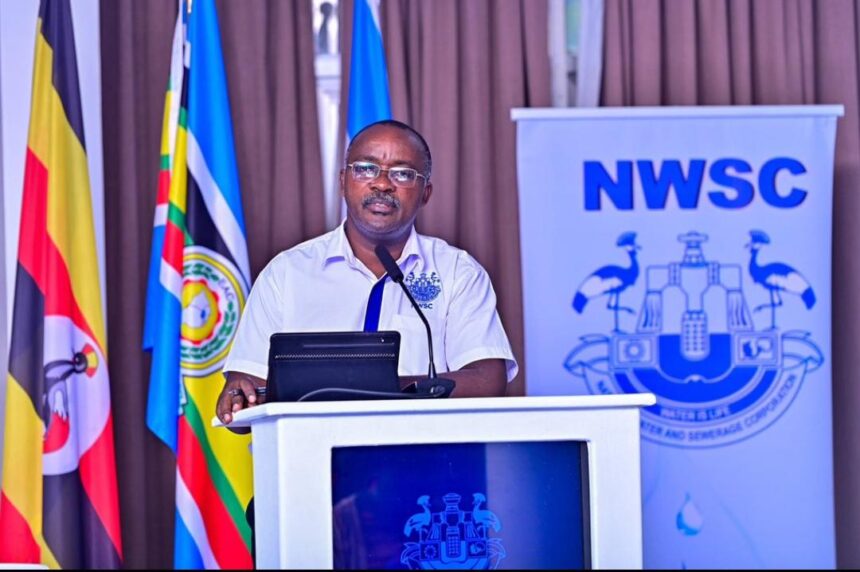
The revelation was made by NWSC Managing Director Eng Dr Silver Mugisha during a media round table held on August 14, 2026, at the NWSC International Resource Centre in Kampala.
Mugisha used the engagement to give the media a detailed account of NWSC’s growth, financial performance, infrastructure expansion, water supply challenges, cost-cutting measures and management’s response to a number of controversies surrounding the corporation.
The engagement, held under the theme “NWSCWorks: Driving Social and Economic Transformation in Uganda,” was also aimed at explaining how investments in water and sanitation are contributing to public health, livelihoods, education and local economic activity.
Research Finds News Uganda (RFN)interviewed Dr Mugisha on the sidelines of the media round table, where he elaborated on the corporation’s performance, the challenges facing the national water utility and the measures being taken to improve service delivery.
Below are excerpts from the interview:
Q: Dr Mugisha, how much has NWSC changed over the past decade?
Mugisha: The transformation has been substantial. Over the last ten years, NWSC has expanded its operations, infrastructure and customer base at an unprecedented pace.
Our customer connections have grown from about 300,000 to more than 1.06 million, with the current target and broader connection footprint projected at about 1.25 million connections.
The water network has also expanded from approximately 6,000 kilometres to 25,000 kilometres, with the broader network now approaching 30,000 kilometres.
These are not simply numbers. They represent millions of Ugandans who previously had limited or no access to reliable piped water.
Q: What about the financial side of the growth?
Mugisha: The corporation’s annual operating surplus before depreciation has grown from around Shs40 billion to about Shs197 billion, with the latest internal projection putting it closer to Shs250 billion, subject to verification through external audit.
Our assets under management have also increased enormously, from about Shs580 billion to approximately Shs6.2 trillion.
At the same time, our service footprint has expanded from 23 towns to approximately 290 towns, while the population served has grown from around 4.5 million to about 25 million Ugandans.That is a very significant transformation.
Q: With such rapid growth, why are some parts of Kampala still experiencing unreliable water supply?
Mugisha: We acknowledge that there are areas experiencing supply challenges, not only in Kampala Metropolitan Area but also in some other operational areas.The reality is that urban populations are growing extremely fast. Industrialisation is also increasing demand.
In some areas, population growth and industrial activity have outpaced the immediate capacity of existing distribution networks.We are therefore implementing water supply stabilisation programmes in several towns.These programmes are aimed at optimising distribution networks, upgrading pumping capacity, eliminating dry zones and ensuring that water is distributed more equitably.
Q: Is money the biggest obstacle to solving these supply problems?
Mugisha: Financing is certainly one of the challenges.Some of the interventions require major capital investments, including network upgrades and additional infrastructure.We are, however, stretching our operational revenues as prudently as possible and working with development partners to address the gaps.Our objective is to stabilise supply while ensuring that the expansion of services remains financially sustainable.
Q: NWSC has been praised for cost efficiency. What is behind this?
Mugisha: We have a deliberate management strategy based on several pillars.
One of them is force-account contracting.For medium-sized projects, we increasingly use our own technical teams and direct labour instead of outsourcing everything to external contractors.This reduces project costs and can also shorten implementation timelines.
Q: How much work is NWSC doing internally instead of hiring consultants?
Mugisha: A lot.
We have invested heavily in internal technology and engineering capacity.For example, we have developed several digital systems internally, including e-payment and billing systems, e-procurement and financial and accounting systems, the electronic Human Resource Management System and the Electronic Water Quality Management System.
This allows us to design, deploy and maintain systems without paying the premium that can come with continuously relying on external technology vendors.We have also built strong internal engineering design capacity.
Q: Which major projects have been designed internally?
Mugisha: Several.Our internal engineering teams have been involved in projects such as the Kapenguria Water Treatment Plant in Kapchorwa, the Lira water improvement project and the Skanka/Kisoro water supply project.They have also worked on regional water supply systems in places including Karungu, Kyankwanzi, Lyantonde, Kapeeka, Soroti, Hoima, Kitgum, Bushenyi and Kanungu.Our engineers are also handling extensive network expansion and rationalisation work in Greater Kampala and other parts of the country.The idea is simple: instead of spending money unnecessarily on external consultants, we invest in our own people and put the savings directly into infrastructure.
Q: What other measures have helped NWSC control costs?
Mugisha: We have a very deliberate cost-efficiency strategy.We use special audits to strengthen financial discipline and identify areas of waste.We have also introduced internal incentive contracting, linking performance milestones to incentives in order to improve productivity.
During emergencies or periods of heavy workloads, we use structured task-force overtime arrangements instead of automatically outsourcing specialised work.We have also aggressively embraced digitalisation to reduce paperwork, bureaucratic delays and administrative costs.
Q: You have also introduced stricter performance management. What does this involve?
Mugisha: We monitor staff output through structured performance frameworks, including quarterly appraisals.We have also introduced a part-time employment mechanism aimed at ensuring public resources are linked to actual and measurable work.The objective is not to punish employees. It is to make sure that every shilling spent by the corporation produces value.
Q: How are you keeping your workforce capable of handling these challenges?
Mugisha: Continuous learning is critical.A modern water utility requires engineers, scientists, technicians, ICT specialists and managers who are constantly updating their skills.We therefore treat capacity building as a continuous process.Our workforce must remain agile and capable of handling increasingly complex utility challenges.
Q: What is your position on contractors and third-party service providers?
Mugisha: We have a zero-tolerance approach to contractual breaches.Where we engage external vendors, they are expected to deliver exactly what they have been contracted to deliver.Our procurement and contract-management systems are designed to ensure value for money and protect public resources.
Q: There have been questions about NWSC’s prepaid metering project. What is the corporation’s position?
Mugisha: The prepaid metering matter was comprehensively audited by the Public Procurement and Disposal of Public Assets Authority during the 2020/2021 financial year.Management implemented the recommendations arising from that process, and PPDA subsequently closed the inquiry in 2021.We therefore believe the matter should be considered in the context of the findings and actions that were already taken.
Q: What about the 2023 computer hacking incident?
Mugisha: Following the incident, we engaged independent cybersecurity experts to conduct a forensic investigation.The Office of the Auditor General also conducted a detailed review of our IT architecture.
Where individuals were found to have been compromised, disciplinary measures were taken.We also implemented the structural recommendations arising from the Auditor General’s review to strengthen our cybersecurity governance.
Q: NWSC has also changed its insurance model. Why?
Mugisha: We moved from traditional high-premium risk-transfer insurance to a risk-retention model managed through an independent risk management firm.The decision was based on probability analysis and value-for-money considerations.The model has saved NWSC more than Shs10 billion, which has been redirected into water infrastructure.We are now developing an independent risk fund to help the corporation manage future liabilities.
Q: There has been criticism over retaining some employees beyond the retirement age of 60. Why does this happen?
Mugisha: Retention beyond 60 is not automatic.It is a carefully controlled exception managed by the Board under the NWSC Human Resources Manual.It is reserved for mission-critical areas where immediate retirement could create service gaps while younger staff are being developed to take over.
Some of the allegations surrounding these arrangements, in our view, come from individuals whose requests for special post-retirement contracts were not approved.
Q: What about NWSC’s acquisition of the former Crane Hotel in Bushenyi?
Mugisha: That acquisition was part of a broader strategy to establish regional training hubs.The procurement followed an open bidding process and was provided for in the NWSC Corporate Plan.Similar facilities are being developed at Ggaba and Kachung in Lira.The Bushenyi acquisition went through the required statutory processes, including valuation by the Chief Government Valuer and legal clearance by the Solicitor General.
Q: There have also been questions about Katosi Water Works and other major projects. What is your response?
Mugisha: Major procurements, including Katosi Water Works and recent Kampala projects, were handled under the applicable donor procurement guidelines and PPDA laws governing internationally financed projects.The allegations were investigated by the Inspectorate of Government, PPDA and international development partners.According to the findings available to management, those independent processes did not establish wrongdoing.
Q: Finally, what message do you have for Ugandans and critics of NWSC?
Mugisha: We support the fight against corruption. We welcome objective and fact-based criticism because it helps us improve.But we also believe public debate should be based on facts and genuine public interest.Our staff work extremely hard, sometimes under very difficult conditions, to ensure Ugandans receive water and sanitation services.
The corporation therefore welcomes scrutiny, but we do not believe that character assassination, bad-faith attacks or politically motivated social media campaigns help the public.The message from NWSC is that the work continues.Uganda’s water demand is growing, cities are expanding, industries are emerging and millions more people need reliable services.
Our responsibility is to keep expanding the network, stabilising supply, improving efficiency and ensuring that every shilling invested in the water utility translates into better services for Ugandans.
#NWSCWorks, Mugisha says, is therefore not merely a slogan it is the corporation’s story of expansion, cost efficiency, infrastructure investment and the continuing battle to keep pace with Uganda’s rapidly changing social and economic landscape.
About The Author