ENTEBBE — Research presented at Makerere University Business School’s 30th Annual International Management Conference is putting evidence at the centre of debates on how Uganda and other African countries can turn knowledge into innovation, productivity and sustainable development.
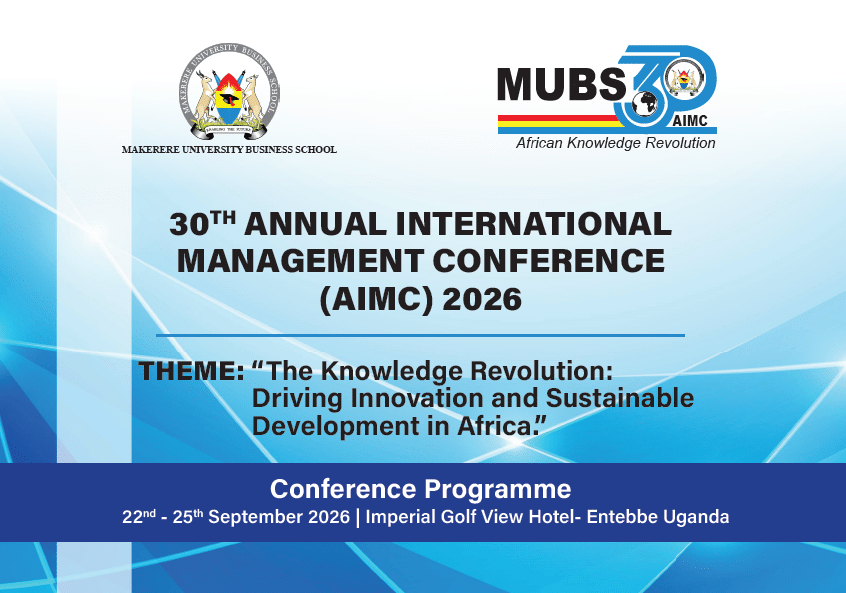
The four-day conference, running from September 22–25 at Imperial Golf View Hotel in Entebbe, has brought together researchers, policymakers, practitioners and other stakeholders under the theme “The Knowledge Revolution: Driving Innovation and Sustainable Development in Africa.”
Unlike a conference focused only on academic exchange, the 2026 AIMC programme is structured around research questions with implications for policy and practice—from artificial intelligence and digital transformation to climate action, financial inclusion, entrepreneurship, governance and sustainable development.
The research agenda includes studies on credit rationing and enterprise financial growth in Uganda, drawing on the World Bank Enterprise Survey 2025, financial literacy and FinTech among women in agribusiness, governance and sustainability in SACCOs in post-conflict Acholi, and the use of knowledge to position Uganda’s NAROVAC for commercialization of veterinary biologics in East Africa.
Other research presented at the conference examines generative AI and productivity, AI applications in urban traffic management, digital learning, FinTech access for persons with disabilities, blockchain in agricultural value chains, green finance, carbon emissions and sustainable energy among manufacturing SMEs.
The breadth of the research reflects what organisers describe as an emerging African knowledge revolution—a shift from treating knowledge largely as something to consume towards generating, managing, applying and ultimately exporting knowledge from within Africa.
Dr Annet Kabugo Nabatanzi Muyimba, the conference co-chair, argues that Africa’s challenge is not simply producing more research, but gaining greater control over the knowledge value chain, from data generation and storage to analysis and application.
That proposition gives the conference a distinctly research-to-impact dimension.
The programme identifies 14 thematic tracks, covering knowledge leadership and governance, climate action, digital transformation, indigenous knowledge, health and wellbeing, South-South cooperation, entrepreneurship, education, doctoral research, youth and gender, knowledge industries and strategic partnerships.
FROM PAPERS TO POLICY
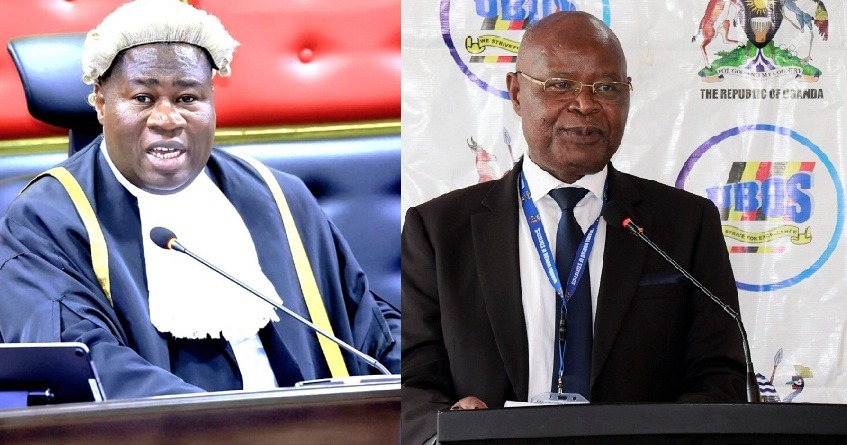
The conference’s policy relevance has also been reinforced by Finance Minister Henry Musasizi, who called on policymakers to base government decisions on credible research rather than unsupported opinion.
Musasizi made the remarks while officiating at the conference, urging researchers and policymakers to ask a basic question whenever policy proposals are presented: where is the evidence?
His message closely mirrors the conference’s stated objective of strengthening the link between research, policy and practice.
The AIMC programme says research should not end with publication or academic discussion, but should contribute evidence, policy insights and practical recommendations capable of informing development.
MUBS Principal Prof. Moses Muhwezi similarly frames the university’s research mission around translating academic knowledge into practical solutions, while the conference leadership identifies evidence-based decision-making, research collaboration and innovation as central outcomes of the event.
The Deputy Principal, Assoc. Prof. Rachel Mindra Katoroogo, similarly highlights the role of academic conferences in allowing researchers to present their work, receive constructive feedback, improve their studies and translate findings into high-quality publications and practical knowledge.
She also points to the importance of building research teams, developing joint projects and grant proposals, and creating partnerships across institutions and countries.
For a research ecosystem seeking greater societal impact, that connection between research generation and its eventual application remains a critical part of the conference agenda.
AI, CLIMATE AND THE NEXT KNOWLEDGE ECONOMY
Artificial intelligence is one of the clearest emerging research fronts at the conference.
The programme includes studies examining generative AI in knowledge work and productivity, its implications for the social fabric of firms, AI applications in urban traffic systems and digital knowledge platforms for Uganda’s TVET sector.
Climate and green growth form another major research stream, with studies addressing gendered climate impacts, green finance and carbon emissions in East Africa, electricity price forecasting, sustainable energy and the capacity of manufacturing SMEs to absorb and use new knowledge.
The conference therefore places technological change and climate pressure within the same development conversation: how can African institutions generate and use knowledge quickly enough to respond to rapidly changing economic, environmental and social conditions?
FROM LOCAL EVIDENCE TO CONTINENTAL DEVELOPMENT
The research agenda also extends beyond conventional management studies.
Papers examine indigenous knowledge, hospitality and cultural heritage, including cultural tourism, indigenous restaurants, tourism benefit-sharing and food-waste management in Kampala hotels. Other tracks address health and social wellbeing, procurement, financial governance, youth and gender, entrepreneurship, education and global market competitiveness.
This broad scope reflects the conference’s argument that knowledge management is not a narrow corporate function but a potential development tool cutting across government, universities, communities, businesses and industries.
The organisers have linked the conference to Uganda’s national development priorities as well as the African Union Agenda 2063, the African Continental Free Trade Area and the Sustainable Development Goals, positioning research as an input into wider economic and social transformation.
For RFN, the significance of the conference lies therefore not simply in the number of papers being presented, but in the questions those studies raise about whether research evidence is being converted into products, policies, technologies, institutions and measurable development outcomes.
The 30th AIMC provides a platform for that conversation, with doctoral research, peer exchange, exhibitions, policy dialogues and research presentations running alongside keynote addresses and practitioner engagements.
As Africa confronts technological disruption, climate change, unemployment, inequality and other development pressures, the conference places a fundamental question before researchers and policymakers: how can knowledge produced in Africa be transformed into solutions that work for Africa?
FOUR DAYS OF KNOWLEDGE EXCHANGE
The conference continues through September 25, with subsequent sessions expected to deepen discussions around international research collaboration, postgraduate development, entrepreneurship, governance, inclusive development, knowledge management, hospitality and tourism.
The final day will feature high-level panel discussions before the closing ceremony, which is scheduled to be officiated by the Speaker of Parliament of Uganda, Rt. Hon. Jacob Marksons Oboth.
The event brings together international scholars including Prof. Munshi Sulaiman of the BRAC Institute of Governance and Development, Prof. Andreas Brandner, Prof. Joseph Sekhampu of North-West University, Prof. Ken Kamoche and other researchers and practitioners working across economics, management, governance and knowledge development.
For MUBS, the 30th AIMC represents both a celebration of three decades of the conference and an opportunity to interrogate how African institutions can convert research and knowledge into solutions with measurable social and economic value.
About The Author