By Pius Niwarinda
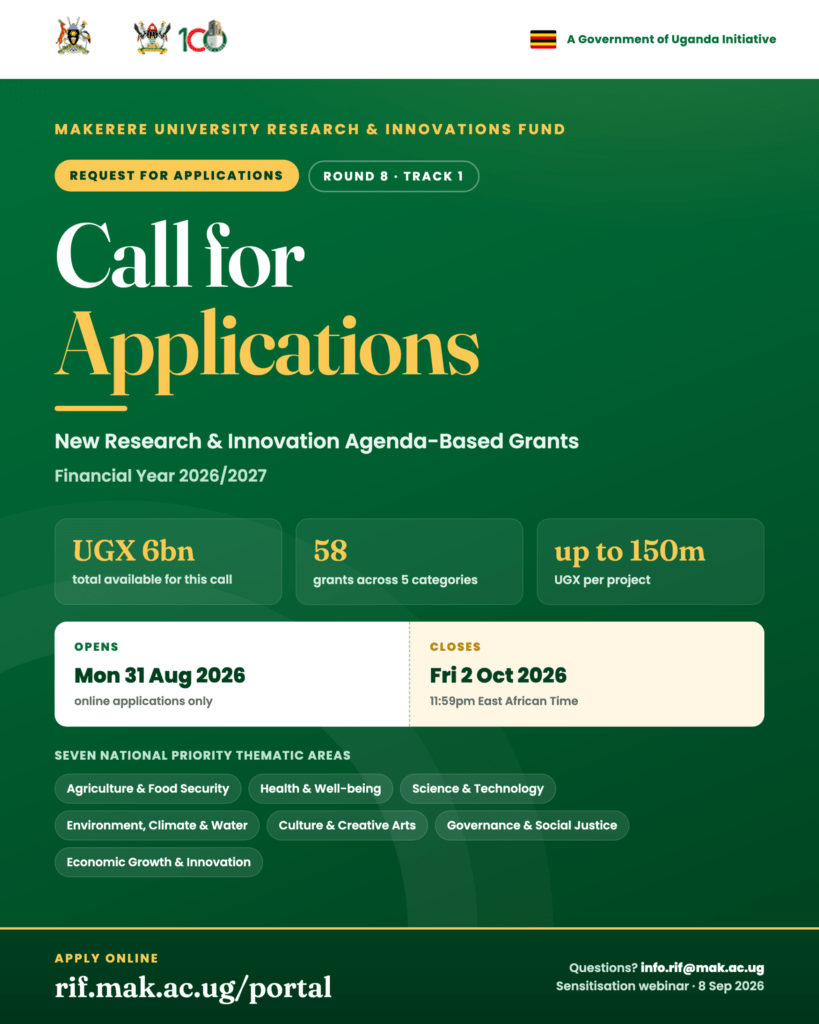
KAMPALA — Makerere University Kampala has opened applications for Shs6 billion in new research and innovation grants, offering researchers an opportunity to secure funding for projects aligned with Uganda’s national development priorities during the 2026/27 financial year.
The funding is being provided under the Makerere University Research and Innovations Fund (Mak-RIF), through the Government of Uganda’s Research and Innovation Fund.
The latest call, known as Round 8, Track 1 — New Research & Innovation Agenda-Based Grants, is targeting at least 58 projects, with individual awards ranging from Shs1 million to Shs150 million, depending on the category.
Applications opened on August 31, 2026, and will be accepted exclusively through the Mak-RIF online application portal until October 2, 2026, at 11:59pm East African Time.
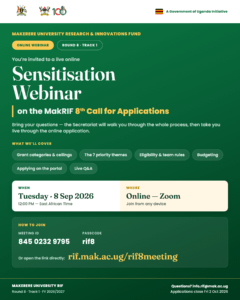
The university is also scheduled to hold a sensitisation webinar on Tuesday, September 8, 2026, at noon, to guide prospective applicants through the call and application process.
What is Mak-RIF?
Mak-RIF is a Government-supported funding mechanism administered through Makerere University to support research and innovations capable of addressing important national development challenges.
Over the past seven financial years, approximately Shs165.5 billion has been appropriated to the Fund, supporting more than 1,480 projects across different sectors. Of these, 783 projects have reportedly been completed.
The latest funding round comes as Uganda implements the Fourth National Development Plan (NDP IV), covering 2025/26 to 2030/31, which identifies research and evidence generation as important tools for addressing development challenges.
For the 2026/27 financial year, Makerere expects to receive about Shs20 billion under the Government Research and Innovation Fund.
At least Shs7 billion is earmarked for new ideas responding to the national Research and Innovation Agenda, with the remainder supporting continuing, multi-year, needs-based and commercialisation or scaling projects.
The current call commits Shs6 billion specifically to new awards.
What kind of research is being funded?
The funding is not restricted to laboratory science or conventional academic research.
Researchers from all technical disciplines can apply, provided their research questions clearly connect to the priority areas of Uganda’s Research and Innovation Agenda.
The seven priority thematic areas are:
Agricultural Transformation, Food Security and Livelihoods—focusing on research that can transform agriculture and improve livelihoods.
Health and Well-being—covering research aimed at improving sustainable health outcomes.
Science and Technology—including education, ICT and technologies that can strengthen national development.
Natural Resources, Environment, Climate Change, Land and Water Management—covering areas such as water, sanitation, environment, energy and minerals.
Cultural Heritage and Creative Arts—including culture, tourism, wildlife and heritage.
Governance, Social Justice and Equity—covering law, governance, human rights, peace, public administration and related issues.
Economic Growth and Innovation— covering enterprise, finance, manufacturing, science and technology, commercialisation and other drivers of economic growth.
The emphasis is on research that can produce evidence, solutions, products, policies or approaches that can be translated into practical results.
How much money can researchers get?
The Shs6 billion funding package has been spread across five categories, giving researchers different funding options depending on whether they are developing a new idea or scaling up an innovation that has already been proven.
Under Category 1a, researchers with new ideas can apply for between Shs100.001 million and Shs150 million, with at least 15 projects expected to receive funding, accounting for Shs2.25 billion of the total allocation.
Category 1b provides between Shs50.001 million and Shs100 million for new ideas. At least 20 projects will be funded under this category, with a total allocation of Shs2 billion.
For researchers seeking smaller grants, Category 1c offers between Shs1 million and Shs50 million for new ideas. At least 15 awards are planned, with Shs750 million allocated to the category.
The Fund is also targeting innovations that have moved beyond the early research stage and are ready for wider application. Under Category 2a, proven ideas ready for scaling can receive between Shs100.001 million and Shs150 million, with at least four projects set to share Shs600 million.
Meanwhile, Category 2b offers between Shs50.001 million and Shs100 million to proven ideas that are ready to scale. At least four projects will be supported under this category, with Shs400 million available.
Together, the categories provide for a minimum of 58 awards.
However, the Grants Management Committee reserves the right to adjust the number and size of awards depending on demand, the quality of applications, available funds and utilisation by previous grantees.
Researchers should therefore select their funding category carefully.
An application requesting more than the ceiling for its chosen category will be automatically disqualified.
New idea or ready-to-scale innovation?
One of the important distinctions in this call is between genuinely new ideas and innovations that have already demonstrated potential.
Category 1 is for new ideas with transformative potential.
These may involve research addressing a critical knowledge gap, an innovation responding to a significant community or technology challenge, or an initiative designed to strengthen the research and innovation ecosystem.
Category 2, on the other hand, is for proven products or ideas that are ready to move towards scale.
Applicants in this category must demonstrate that their idea has passed proof of concept and has a minimum viable product or model capable of being scaled commercially or through public-sector adoption.
An early-stage project without proof of concept is therefore not suitable for Category 2.
The Fund is also open to the humanities and arts. In this context, a “product” can include a tangible physical or electronic output, while an “idea” can include a new approach, concept or policy output capable of improving service delivery.
Who is eligible?
The principal applicant, or Principal Investigator (PI), must be an appointed Makerere University academic or research staff member.
The eligible staff must generally be on a permanent appointment or a full-time contract issued through the Directorate of Human Resources. Certain staff in research-linked administrative units are also eligible.
The PI must be actively in service and cannot be on study or sabbatical leave or due for retirement during the project period.
Each application must also identify a Co-Principal Investigator (Co-PI) who meets the applicable eligibility requirements and shares responsibility for the project.
Applicants must attach a letter of support from their department, school or college as well as their appointment or most recent promotion letter.
A researcher can serve as PI on only one application, although they may participate as a team member on up to three applications.
Collaboration with researchers and specialists from other universities, Government agencies, civil society, business and industry is encouraged.
Students may participate in project teams but cannot apply as Principal Investigators.
A warning for previous Mak-RIF beneficiaries
Researchers who already have active Mak-RIF projects have been asked to pay particular attention to the eligibility rules.
A PI or Co-PI holding an active award from previous RIF rounds — including RIF-1 through RIF-7 — will not be considered for a new award if the earlier project has not been officially closed.
Projects with pending accountabilities or without completed official close-out reports can result in rejection of a new application.
The Fund is also encouraging researchers who have applied unsuccessfully in previous rounds to try again.
Junior academics, including lecturers and researchers with fewer than five years of research experience, are particularly encouraged to participate.
What will make an application competitive?
Mak-RIF is looking beyond academic merit alone.
Applicants need to demonstrate that the problem they are addressing matters to Uganda’s development priorities and that the proposed research or innovation can produce useful results.
Strong proposals should clearly explain the problem, proposed solution, methodology, expected outputs, outcomes, impact and beneficiaries.
The Fund also places emphasis on the ability to translate research into policy, practice or scalable products.
Projects that include relevant industry, business, public-sector or implementation partners may have an advantage because they can demonstrate a clearer route from research to adoption.
Researchers are also encouraged to incorporate mentorship of students and junior faculty and to demonstrate how their work will strengthen institutional capacity.
Another important consideration is time.
The grants are for a single financial year, meaning applicants must show that tangible deliverables can be achieved within one year.
Even where a project forms part of a longer-term programme, the proposal must identify meaningful results that can be delivered during the funded year.
What about the budget?
Applicants must prepare their budgets in Uganda Shillings and limit expenditure to the one-year funding period.
Institutional overheads are not permitted.
Regular personnel costs, excluding field research assistants, must not exceed 33 per cent of the total budget.
Applicants must also submit a detailed budget and justification in Microsoft Excel and remain within the ceiling of their selected grant category.
Ethical considerations, environmental impacts and the necessary approvals or certifications must also be addressed where applicable.
How will applications be assessed?
Applications will go through a three-stage review process.
First, the Mak-RIF Grants Management Committee Secretariat will check whether applicants meet the eligibility requirements.
Proposals that pass this stage will proceed to technical review by independent national and international reviewers.
Each proposal will be assessed by at least three reviewers using standardised criteria.
The final stage will involve the Grants Management Committee selecting successful proposals from the highest-scoring applications.
The assessment considers the quality of the problem being addressed, proposed solution, technical approach, methodology, expected results and impact, team composition, capacity building, dissemination and scalability, as well as feasibility.
Proposals are scored out of 100 marks.
The final selection can also take into account factors such as alignment with the national Research and Innovation Agenda, sector impact, equity among Makerere colleges, gender and junior-faculty representation, budget considerations and available funding.
When should applicants apply?
The application window is already open.
The key dates are:
August 31, 2026: Applications open.
September 8, 2026: Researcher sensitisation webinar.
September 8–22, 2026: Question-and-answer period.
September 25, 2026: Frequently Asked Questions posted and researcher support webinar held.
October 2, 2026, at 11:59pm EAT: Applications close.
Eligibility screening is scheduled for October 5–9, followed by technical review from October 9 to November 13.
The Grants Management Committee is expected to make its final selections between November 16 and 19, with award notifications scheduled for November 20.
Successful applicants will undergo mandatory induction on November 24, 2026.
How do you apply?
Applicants have been asked to submit online through the Mak-RIF portal.
Applicants should register or log into the portal, complete the application form and upload the required supporting documents.
The application can be prepared offline using the downloadable PDF or Word version before the information is transferred to the online form.
The required attachments include a letter of institutional support, the PI’s short-form CV and a detailed budget with justification.
Applicants working with external institutional partners should also provide the required letters of support.
The Grants Committee will not consider applications submitted through alternative channels, and applicants should ensure they complete the final submission before the deadline.
With billions of shillings available and competition expected to be high, the message to prospective applicants is straightforward: a strong academic idea is not enough. Researchers must show why the problem matters, how the proposed solution will work and, most importantly, what Uganda stands to gain from the research.
Sensitisation webinar
Researchers who are new to Mak-RIF or need clarification before submitting their proposals can attend the online sensitisation meeting on Tuesday, September 8, 2026, at 12:00pm EAT.
The meeting will be held via Zoom.
Meeting ID: 845 0232 9795
Passcode: rif8
The Fund has also provided info.rif@mak.ac.ug as the contact for questions and application support.
About The Author