Kampala- Uganda: Uganda’s National Council for Higher Education (NCHE) has drawn a red line against the rising culture of title-chasing by honorary degree holders in the country’s public life
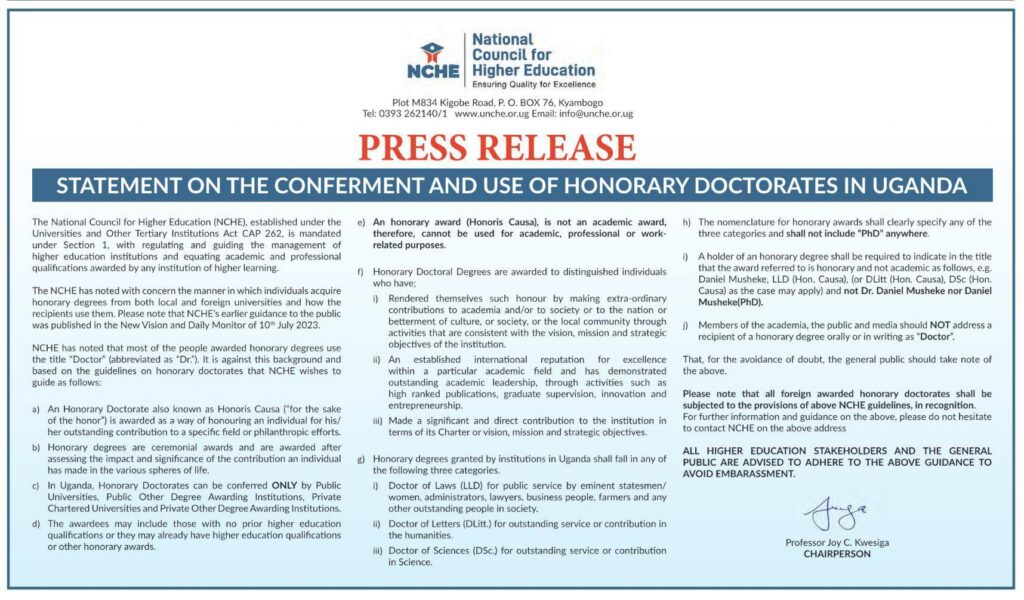
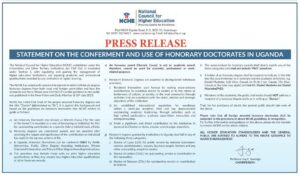
In a formal press release yesterday, the statutory body mandated to regulate and guide the management of higher education institutions issue unambiguous guidance on the conferment and use of honorary doctorates in Uganda.
The message, signed by the NCHE chairperson Prof. Joy Kwesiga and stripped of its legal language, is simple: an honorary degree is not a real degree, and the people who hold one cannot call themselves “Doctor.”
That this needed saying at all is a measure of how far the rot has spread in public life by a section of national political and business leaders with little inspiration for the young generation working hard to attain this high-level academic qualification in a country set on a knowledge economy mission.
What the NCHE Has Said
The Council’s statement, signed by Chairperson Professor Joy C. Kwesiga, clarifies several things that some Ugandans have been either genuinely confused about or deliberately obscuring.
She wrote: An Honorary Doctorate — known formally as Honoris Causa, Latin for “for the sake of the honour” — is, in the NCHE’s own words, not an academic award. It cannot, therefore, be used for academic, professional, or work-related purposes. It is a ceremonial recognition, awarded to distinguished individuals who have made extraordinary contributions to society, culture, or a field of endeavour. It is not earned through years of supervised research, a defended thesis, or the rigorous peer scrutiny that a genuine doctorate demands.
In the statement, she guides those Honorary degrees in Uganda may only be conferred by accredited institutions — Public Universities, Public Other Degree Awarding Institutions, Private Chartered Universities, and Private Other Degree Awarding Institutions. They fall into three categories: Doctor of Laws (LLD) for public service; Doctor of Letters (DLitt) for contributions to the humanities; and Doctor of Sciences (DSc) for contributions to science.
Here is the part that matters most, and that the NCHE could not have stated more clearly: “The title “PhD” shall not appear anywhere in connection with an honorary award. A holder must indicate that their award is honorary — writing, for example, LLD (Hon. Causa) — and not Dr. anything. The general public and the media, the statement adds, should not address a recipient of an honorary degree as “Doctor,” orally or in writing,” Prof. Kwesiga adds.
Why This Matters — and Why It Has Been Ignored
Uganda has developed an appetite for honorary degrees that would be comic if its consequences were not serious.
Politicians, businesspeople, pastors, and public figures have accumulated these awards from institutions both local and foreign — some of questionable standing — and proceeded to rebrand themselves as doctors with a speed and confidence that genuine PhD holders, who spent years in libraries and field sites earning the title, can only watch with a mixture of disbelief and quiet fury.
The damage is not merely symbolic. When titles lose their meaning, the institutions that grant legitimate ones lose their authority.
When a person with an honorary degree from a foreign institution of uncertain reputation introduces themselves as “Dr.” to a government committee, a board of directors, or a television audience, they are not merely enjoying an honour. They are misrepresenting their qualifications.
In any other professional context — medicine, law, engineering — this would be actionable. In Uganda’s public life, it has been treated as a perk.
The NCHE is right to step in, and right to make this guidance public. The Council’s earlier notice, published in the New Vision and Daily Monitor in July 2023, evidently did not suffice.
“The fact that a formal press release has been required at all tells you something about the stubbornness of the habit,” says Dr. Nelson Nsereko, a Lecturer at the School of Languages, Literature and Communication,Makerere University.
Prominent leaders pursuing doctorates
Information gathered by this website indicates that three prominent leaders in the ruling NRM government in Uganda are currently pursuing doctoral degrees at universities here and abroad. These are: The Vice President of Uganda Maj (RTD) Jessica Alupo (Makerere University), Prime Minister Robinah Nabanja (Nkumba University) and Eng Jonard Asiimwe, the Minister of Science Technology and Innovation whose is pursing his in Oil and Gas stakeholder Engagement.
A Direct Word to Those Who Use the Title Wrongly
If you hold an honorary degree and you have been going by “Dr.” — in your email signature, on your business card, in how you introduce yourself to journalists, at public forums, on your social media profile — you are now on notice from Uganda’s statutory academic regulator.
The NCHE has not been ambiguous. It has not left wiggle room. It has said what the title means, what it does not mean, and what it cannot be used for.
The honest response is to correct the record. Remove the “Dr.” Update the title. Introduce yourself accurately.

There is no dishonour in being recognised for a genuine contribution to society — which is what a legitimate honorary degree represents. The dishonour is in dressing that recognition up as something it is not, and using it to claim an academic authority you did not earn.
Uganda’s universities are training real researchers, producing real knowledge, and graduating real doctors — people who have given years of their lives to the demanding, often lonely, and genuinely important work of advancing human understanding. They deserve a title system that means something.
The NCHE’s statement is a step toward restoring that meaning.
About The Author